


Now hold all of that. Keep the devshirme in your head. Keep Skanderbeg on the walls of Krujë and Ballaban dying outside them. Keep the eight boys tortured for a year. Keep Sokollu restoring the Serbian Patriarchate with Ottoman money. Keep the 6,000 dead in Istanbul in 1826.
And open a manga from 1970.
Ishinomori’s Architecture: From Skull Man to Kamen Rider
Skull Man: The Unfiltered Version
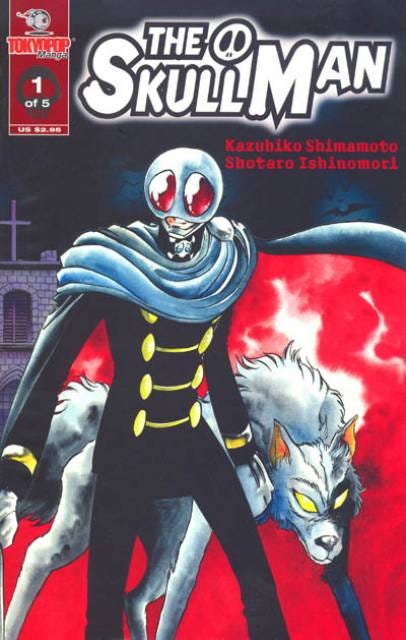
Shotaro Ishinomori published Skull Man as a hundred-page one-shot in Weekly Shōnen Magazine in 1970. It sold over 1.5 million copies. The protagonist is Tatsuo Kagura, eighteen years old, an orphan whose parents were murdered. He takes the name Skull Man. His only companion is Garo, an artificial creature. He pursues vengeance against the people who destroyed his family.
That description makes him sound like a hero. He isn’t.
Skull Man kills innocents. He kills indiscriminately. Ishinomori designed him to frighten children. The press in the story’s world censors his existence because the public can’t handle knowing he’s out there. He is manga’s first anti-hero by most credible accounts, and the reason he’s the first is that nobody before Ishinomori had the nerve to build a protagonist this ugly. A person made monstrous by what was done to him, who turns that monstrousness outward without much caring where it lands.
The weapon is loose. And it doesn’t care who’s standing in the way.
This is the honest version of the escaped-weapon story. The version where the system’s product, once freed, isn’t a savior. He’s damaged. Dangerous. Shaped entirely by the violence that made him. Skull Man is what Skanderbeg looks like if you strip away five centuries of national mythology and look at the warlord underneath: a man who burned a quarter-century of his life making war, trained to kill by the people he was killing, incapable of becoming anything other than what the system built him to be.
The Transition
In 1970, Toei Company producer Toru Hirayama came to Ishinomori looking for a TV superhero. Ishinomori pitched Skull Man.
Toei said no. Too dark. Too violent. A hundred pages of an anti-hero slaughtering people wasn’t going to work as a children’s show airing on Saturday mornings.
So they softened it. The skull motif became a grasshopper. Ishinomori’s son reportedly picked the insect. The indiscriminate violence became directed heroism. The moral ambiguity got scrubbed out for broadcast.
On April 3, 1971, Kamen Rider premiered on Japanese television.
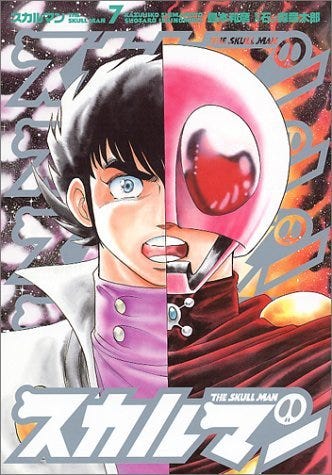
The underlying machinery was untouched. A person is seized. Remade into a weapon. Escapes before the process is complete. Turns against the system that made him. The structure survived the transition from Skull Man to Kamen Rider perfectly intact. What changed was the moral packaging. The escaped weapon became a good guy.
This mirrors something in the Ottoman parallel that I think is worth flagging: the same softening happened to Skanderbeg over centuries of Albanian folk memory. The warlord who fought a brutal guerrilla campaign for twenty-five years became a clean national hero, a symbol of freedom, a figure on stamps and statues. Ishinomori told the raw version in 1970 and the mythologized version in 1971. Albanian culture did the same thing over five hundred years. Different timescales. Same process. The escaped weapon gets cleaned up for the audience that needs him.
Kamen Rider: The Hero
Takeshi Hongo is a college student. Shocker, a global terrorist organization, kidnaps him and surgically alters him into a cyborg. The Japanese term is kaizō ningen, “modified human.” They graft animal and insect DNA into his body alongside cybernetic enhancements. The conversion happens while Hongo is unconscious.
The brainwashing doesn’t.
Dr. Hiroshi Midorikawa, a scientist working inside Shocker, intervenes before the final step. He gets Hongo out. Later, when Shocker tries the brainwashing again, Hongo uses self-hypnosis to resist. The body is Shocker’s work. The mind stays his.
In Ishinomori’s manga, the version he drew himself, Hongo is wrecked by this. He hates what he’s become. He looks at his cyborg body and sees a monster, something Shocker built, something that isn’t fully human anymore. He carries that self-loathing for a long time before he accepts who and what he is and decides to use Shocker’s modifications against them.
The gap between physical transformation and mental subjugation is Hongo’s entire story. That gap is where his freedom lives. It’s a thin space. Everything Hongo is as a hero exists because of one incomplete step in a process designed to produce an obedient weapon.
Sound familiar?
Shocker: The Antagonist as Empire
Shocker wants to conquer the world. The method: kidnap human beings, surgically modify them into mutant cyborgs called Kaijin, brainwash them, and deploy them. The organization’s scientists are themselves coerced, kidnapped specialists forced to work under threat of death. When a scientist stops being useful, Shocker kills them. When a scientist tries to escape, Shocker kills them.
The Kamen Rider Spirits manga connects Shocker’s founders to former Nazis. The fictional organization is rooted in the specific history of twentieth-century totalitarianism. The Great Leader of Shocker’s stated endgame is the conversion of the entire human race into Kaijin, a single unified entity under his control.
Shocker doesn’t want to rule people. It wants to replace them. Every human being is raw material waiting to be processed. The person who walks into a Shocker lab ceases to exist. What walks out is an instrument. A tool. Property.
The devshirme, with surgical tables instead of circumcision rites and cybernetic implants instead of Turkish language immersion.
The Mirror: Structural Parallels
The Production Cycle
Lay the two systems next to each other and walk through them step by step.
Seizure. Ottoman officials ride into a Christian village and take boys from their families. Shocker operatives kidnap Takeshi Hongo off a street.
Erasure. The Ottoman boy is separated from his parents, his church, his community. He is told to forget his name. Hongo is placed on an operating table, unconscious, his body opened and rewritten without his knowledge or consent.
Remaking. The boy is converted to Islam, given a Turkish name, trained in a new language, acculturated through years of labor in Anatolian villages, then military drilling in Istanbul. Hongo is implanted with insect DNA and cybernetic systems, his body rebuilt into a weapon.
Deployment. The boy enters the Janissary corps. He fights the Sultan’s wars. Hongo is intended to enter Shocker’s Kaijin army. He is meant to fight the Great Leader’s wars.
The key fact in both cases: the subject isn’t killed. He’s replaced. The original person is overwritten with a new one. That’s what makes the escaped weapon so dangerous to the system. Shocker knows exactly what it put inside Hongo, because Shocker put it there. The Ottoman state knew exactly what its Janissaries were capable of, because the state spent a decade building them.
When the product escapes, the manufacturer knows its specifications. That’s terrifying.
What the System Produces
I laid out nine Ottoman figures in Part I. Each one represents a different outcome of the devshirme, a different answer to the question of what happens when you steal a child and remake him. Each one maps onto something in Ishinomori’s world.
Skanderbeg defected. He’s Takeshi Hongo, the escaped hero who fights back.
Ballaban Badera stayed loyal. He’s the Kaijin, the completed product sent to kill the one who got away. He fought his own father across a siege wall and never flinched, or if he flinched we have no record of it.
The Neomartyrs completed the conversion, lived inside it for years, then reversed it at the cost of their lives. They’re the Kaijin who, deep into service, somehow remembered who they were before the table. No escape route, no war. Just the image coming back through.
The eight Christian boys tried to resist from inside and failed. They’re the unnamed captives in Shocker’s labs, the ones the audience never sees, the ones whose resistance ended in a room with no witnesses.
Sokollu Mehmed Pasha subverted from within. He’s Dr. Midorikawa, the insider who uses his position to sabotage the machine. Sokollu restored the Serbian Patriarchate with Ottoman authority. Midorikawa broke Hongo out of Shocker using Shocker’s own infrastructure.
Patrona Halil seized the throne. He deposed a Sultan. This is the anxiety that runs underneath the entire Kamen Rider franchise, the one that never quite gets spoken aloud: the modified human isn’t just a rogue. He’s a rival. He could replace his makers.
Kabakçı Mustafa refused to be replaced. When Selim III tried to build a new army, the old one tore him off his throne. Shocker can’t tolerate Kamen Rider’s existence for the same reason. A superior product, walking around free, is proof that the system’s control has failed.
The Dahijas went rogue and burned everything down. Their tyranny in Serbia triggered a national uprising that eventually ripped a piece of the empire away. This is what happens when Shocker’s methods produce consequences the organization can’t contain. Chaos multiplying beyond the point of retrieval.
The Köprülü family ran the empire. Six Grand Viziers from a single Albanian devshirme line. The stolen children surpassed their masters. This is the thing the Kamen Rider franchise accidentally keeps proving: the hero is always stronger than the organization. Always. Every single series. The modified human surpasses the modifier. The weapon outperforms the arsenal that produced it.
That’s nine outcomes and nine answers to the same question. The point isn’t that Ottoman history and Ishinomori’s fiction are identical. It’s that both expose the same weakness in a system that remakes people as tools: the stronger the tool becomes, the greater the danger if control fails.
The Incomplete Conversion
Skanderbeg served the Ottoman military for roughly two decades before he defected. Whatever identity erasure the devshirme performed on George Kastrioti, it held for twenty years. Then it didn’t. Something remained, or something came back. He raised his family’s banner over Krujë. He used a name the Ottomans gave him, Skanderbeg, “Lord Alexander,” to wage war against the Ottomans. He couldn’t shed the name. He couldn’t shed the military training. He could only point it all in the other direction.
Hongo can’t undo the surgery. His body is Shocker’s work permanently. The grasshopper cyborg form, the enhanced strength, the combat capabilities. All of it stays. He carries Shocker’s modifications for the rest of his life. What he can do, the only thing he can do, is refuse the purpose those modifications were designed to serve.
The hero in both cases is defined by an incomplete process. The devshirme or Shocker did ninety percent of the work. The body was remade, the skills were installed, the power was granted. The last ten percent, the part where the person inside gets erased and replaced with obedience, didn’t take.
Contrast Ballaban. The conversion completed. He fought his brother. He besieged a city defended by his father. Whatever was left of Michael of Badera, it wasn’t enough. The hero and the villain in this story came off the same production line. Same system, same process, same inputs. The only variable is whether that final step, the one that kills the person and replaces them with a tool, finishes.
That’s a specific kind of heroism. Not the heroism of the pure, the untouched, the chosen one born special. The heroism of the partially converted. The hero is always, to some degree, a product of the enemy. He carries the enemy’s work in his body. He fights using skills the enemy gave him. His power comes from the people he’s fighting against. And his freedom, the narrow gap between what was done to his body and what wasn’t done to his mind, is everything.
The Name and the Mask
George Kastrioti was renamed Iskander Bey. After his defection he was known by both names. The Ottoman name stuck. It’s the name Albania remembers him by: Skanderbeg. The imposed identity became inseparable from the person. He couldn’t go back to being George Kastrioti, a minor nobleman’s son from a province the Ottomans swallowed. The devshirme made him Skanderbeg, and Skanderbeg is who he was when he fought the devshirme.
Hongo becomes Kamen Rider. Literally: Masked Rider. The mask is Shocker’s work. The grasshopper cyborg form is what they built him to be. But Hongo wears it to fight them. The mark of captivity becomes a weapon of resistance. He can’t take it off. He can’t go back to being a college student. The transformation is permanent. So he turns it around.
Sokollu Mehmed Pasha kept his Ottoman name for his entire life. He never reclaimed whatever Serbian name he was born with. He used the authority that the Ottoman name gave him, the Grand Vizierate, the full weight of imperial power, to restore the Serbian Patriarchate. The imposed identity became the instrument of preserving the erased one.
In all of these cases, the person can’t return to who they were before the system took them. The process is irreversible. What they can do is repurpose the new identity. Turn it against its creators. The mask becomes the weapon. The Ottoman title becomes a rebel’s banner. The Grand Vizier’s seal restores a church the empire tried to bury.
The State Destroys What It Creates
Selim III tried to replace the Janissaries in 1807. Kabakçı Mustafa and the Janissaries deposed him. Nineteen years later, Mahmud II succeeded where Selim failed, but only by surrounding the barracks with cannon and firing until the problem was solved. Six thousand dead. The corps abolished.
The Dahijas, rogue Janissaries in Serbia, provoked the First Serbian Uprising by overreaching so badly that an entire nation rose against them. The empire’s products, operating outside any command structure, triggered the dismemberment of the empire’s territory.
Shocker pours resources into hunting Kamen Rider. Every episode, every arc. The organization sends Kaijin after Kaijin, devotes operational capacity, sacrifices personnel. Because it has to. It built Hongo. It knows what he can do. An escaped product walking around free, using Shocker’s own technology against Shocker, is an existential problem precisely because of how good the technology is.
Any system that manufactures weapons out of human beings will eventually face the possibility that those weapons turn. The Janissary history shows every version of that turning: defection, subversion, revolt, rogue action, outright seizure of power. The Ottoman state tried integration, accommodation, reform, and finally extermination. Shocker tries the same progression across the franchise. None of it works. The weapon keeps fighting.
The Conscience Inside the Machine
Dr. Midorikawa saved Hongo. He was a Shocker scientist who broke ranks, who looked at the operating table and the unconscious college student strapped to it and decided he couldn’t let the last step happen. He got Hongo out. It probably cost him his life.
Sokollu Mehmed Pasha spent fourteen years as Grand Vizier doing something quieter but structurally identical. He worked inside the system and used the system’s resources to protect the thing the system was designed to destroy. He restored a church. He appointed his Christian relatives to positions of power. He never left. He never raised a banner. He just bent the machinery, degree by degree, toward a purpose its builders never intended.
Ottoman administrators sometimes looked the other way when Balkan families tried to hide their sons from the devshirme. They let circumcision ruses work. They lost paperwork. The system was never airtight. There were always people inside it who cracked, who couldn’t stomach what the machine required of them.
Skanderbeg didn’t defect alone. Three hundred Albanians left with him at Niš. Skull Man has Garo, his artificial companion, the one loyal figure in a hostile world. The escapee rarely operates in isolation. The system produces not just individual defectors but clusters of dissent, small networks of people who recognize each other and move together.
The machine leaks. That’s structural too.
Start with Part I if you came in here: The Collection.

If this series is earning your time, subscribe and keep going. And tell me which figure from Part I maps closest to Hongo in your reading.

Continue with Part III: The Image That Doesn’t Erase, where the argument moves from political machinery to the person the machinery cannot fully replace.