

The Relics of the True Cross and the Veneration of Saint Basil the Great in the 4th Century
Having the honor to be in the presence of these great relics and speak of the history of them.

Before we dive into the history lesson, let me say it was an honor, as it was the first time in my Orthodox Christian life that I had the opportunity to behold not just one but two holy relics. In another article, I will write about the history of Saint Basil Orthodox Church in the little town of Weatherford, Oklahoma, which housed the relics, with drone footage of the exterior of the building. I was able to venerate both relics and was blessed by the true Cross. Such an Honor now, if you enjoy history, pics, and drone footage, make sure to hit subscribe.
The 4th century was a pivotal moment for Christian relic veneration. With Constantine’s Edict of Milan (313) granting Christianity legal status and his mother, Empress Helena, actively searching for the physical remnants of the Passion, the Church suddenly found itself in possession of objects that were believed to connect the faithful directly to Christ himself. Two of the most celebrated relics of this era were fragments of the True Cross (the wood of Christ’s crucifixion) and the bodily remains of Saint Basil the Great (c. 330–379), one of the Cappadocian Fathers and bishop of Caesarea in Cappadocia. Though very different in nature—one a contact relic of Christ, the other the mortal remains of a recently deceased saint—they both became focal points of 4th- and 5th-century devotion and illustrate how quickly the cult of relics developed in the post-Constantinian Church.
The Invention of the True Cross (c. 326–328)
According to the earliest accounts (preserved by Eusebius of Caesarea, Ambrose of Milan, Rufinus, Socrates Scholasticus, Sozomen, and Theodoret), Empress Helena, at the age of nearly eighty, traveled to Jerusalem around 326–328. During excavations on the site of Golgotha (ordered by Constantine to build the Church of the Holy Sepulchre), three crosses were discovered in a cistern along with the titulus (the inscription board reading “Jesus of Nazareth, King of the Jews”).
Church tradition holds that the True Cross was identified when a dying (or dead) woman was miraculously healed upon being touched by one of the three crosses. Helena left a large portion of the wood in Jerusalem under the custody of Bishop Macarius, sent another portion to her son Constantine in Constantinople, and took a smaller fragment back to Rome. Nails purportedly from the crucifixion and part of the titulus accompanied these fragments.
By the late 4th century, pilgrims were already flocking to Jerusalem to venerate the relic. The Spanish pilgrim Egeria (c. 381–384) describes in her Itinerarium the Good Friday liturgy in Jerusalem: the wood of the Cross was placed on a table in the Martyrium basilica, guarded by deacons, and the faithful approached one by one to bow, touch the holy wood with forehead and eyes, and kiss it. The deacons stood watch to prevent anyone from biting off a piece—an early indication of the relic’s perceived miraculous power and the lengths to which people would go to possess even a splinter.
Cyril of Jerusalem (c. 349) proudly declared in his Catechetical Lectures that “the holy wood of the Cross … is distributed piece by piece throughout the whole world,” confirming that by the mid-4th century fragments were already being dispersed as contact relics and placed in churches across the empire.
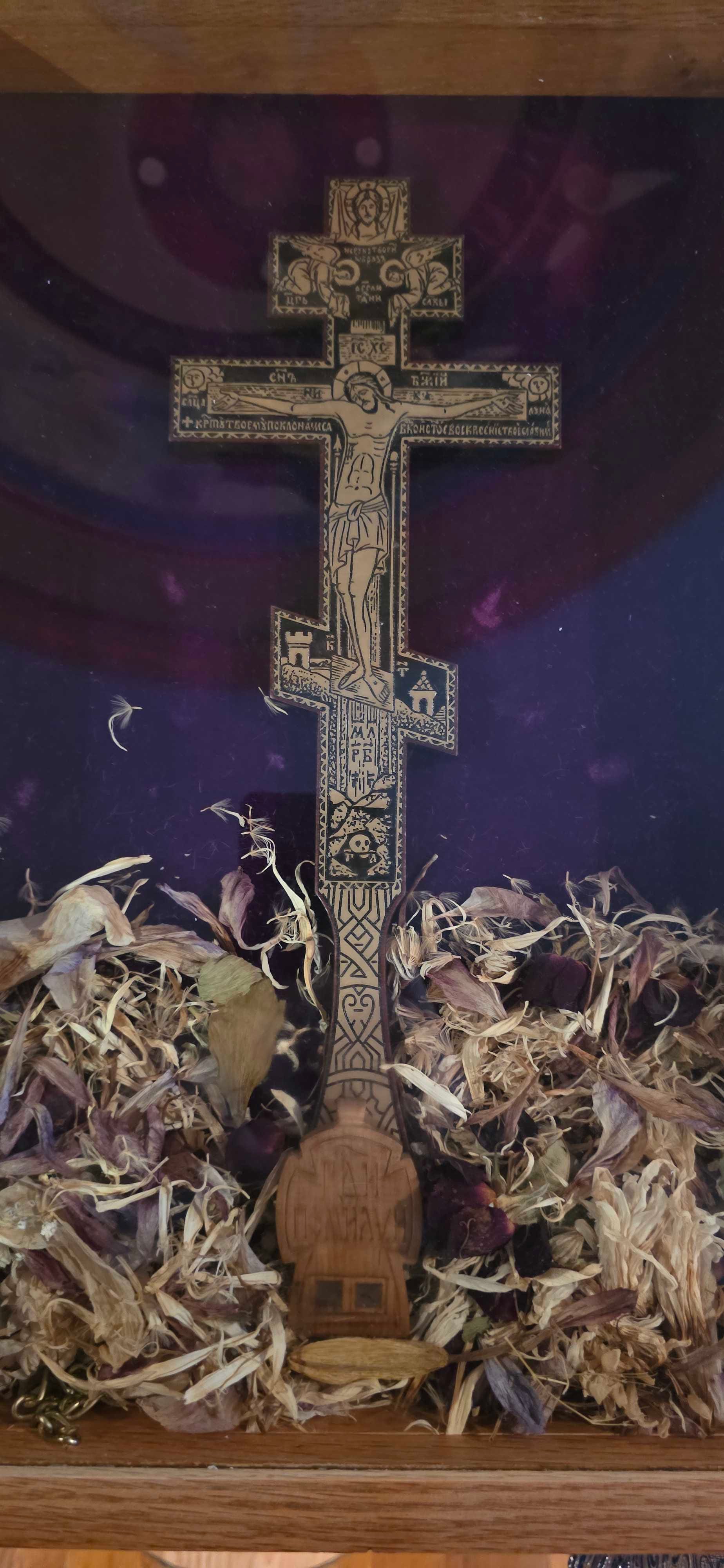
The little cross is from the original cross on which our Lord Jesus was crucified.
The Relics of Saint Basil the Great († 1 January 379)
While the True Cross was a unique instrument of salvation, the bodily remains of contemporary saints quickly became the second great category of powerful relics. Saint Basil the Great, one of the principal architects of Nicene orthodoxy and monastic reform, died on 1 January 379 (or possibly 378) after a long illness. His funeral in Caesarea was a massive public event; Gregory of Nazianzus, his lifelong friend, preached the funeral oration (Oration 43) in 382 amid continuing grief.
Basil’s body was initially buried in the family chapel at Annisi or in the martyrium church in Caesarea. By the early 5th century, however, his remains had been translated into a new basilica built specifically to house them. Amphilochius of Iconium (Basil’s cousin and successor as metropolitan) and Gregory of Nazianzus both refer to miracles occurring at his tomb almost immediately after death, and pilgrims began seeking healing there.
A particularly important relic associated with Basil is a portion of his skull, which eventually made its way to the West. One tradition claims that Emperor Valens (an Arian) had confiscated some of Basil’s relics during the doctrinal struggles of the 370s, and that after Valens’s death at Adrianople in 378, orthodox authorities recovered them. Another tradition holds that in 379–380, shortly after Basil’s death, some relics were sent to Gregory of Nazianzus in Constantinople and to other friends.
By the 6th–9th centuries, major Basil relics were claimed by:
The Great Lavra on Mount Athos (his right hand, still venerated today)
The Basilica of San Francesco in Assisi (a portion of the skull)
Saint Mark’s in Venice
Bruges (Belgium), which possesses a famous reliquary of “the skull of Saint Basil” brought back by Crusaders or earlier pilgrims.
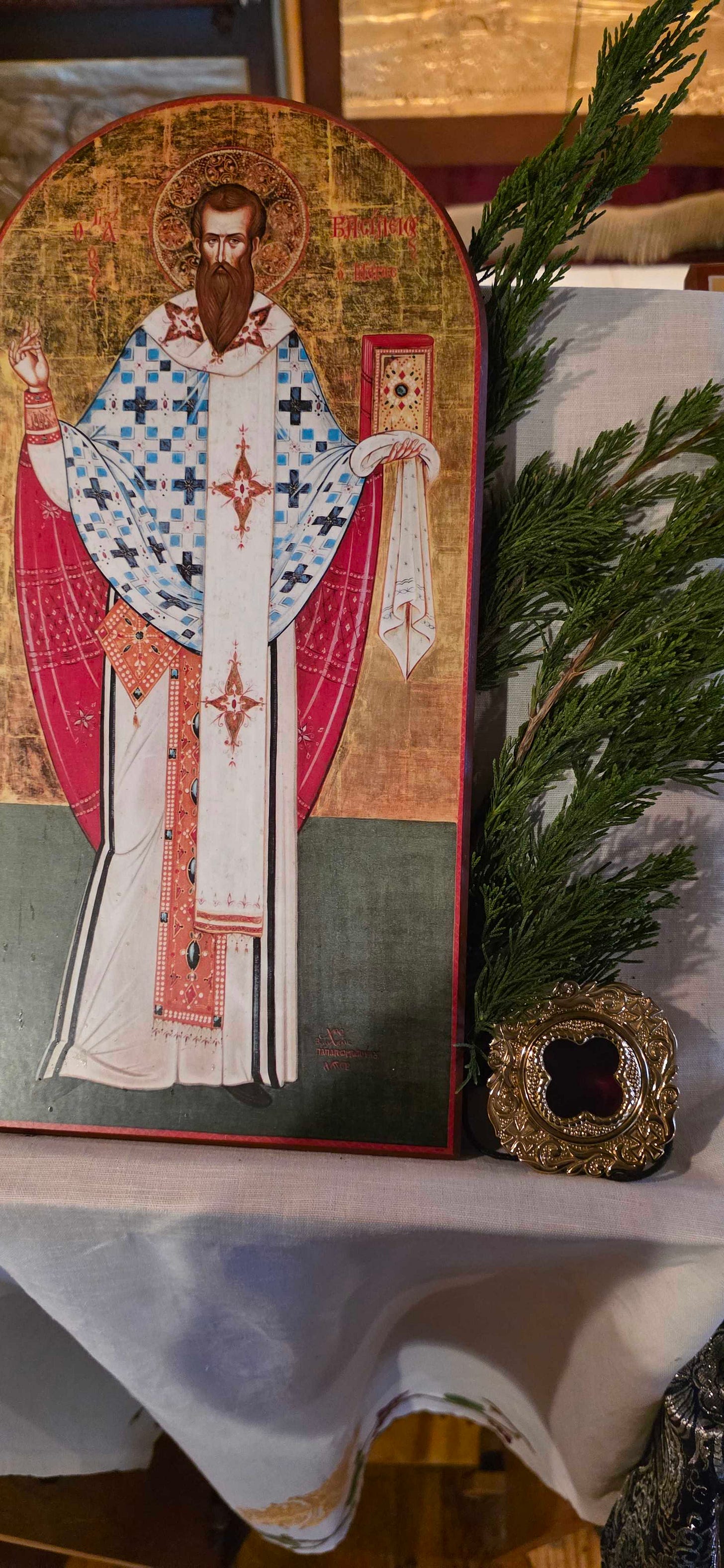
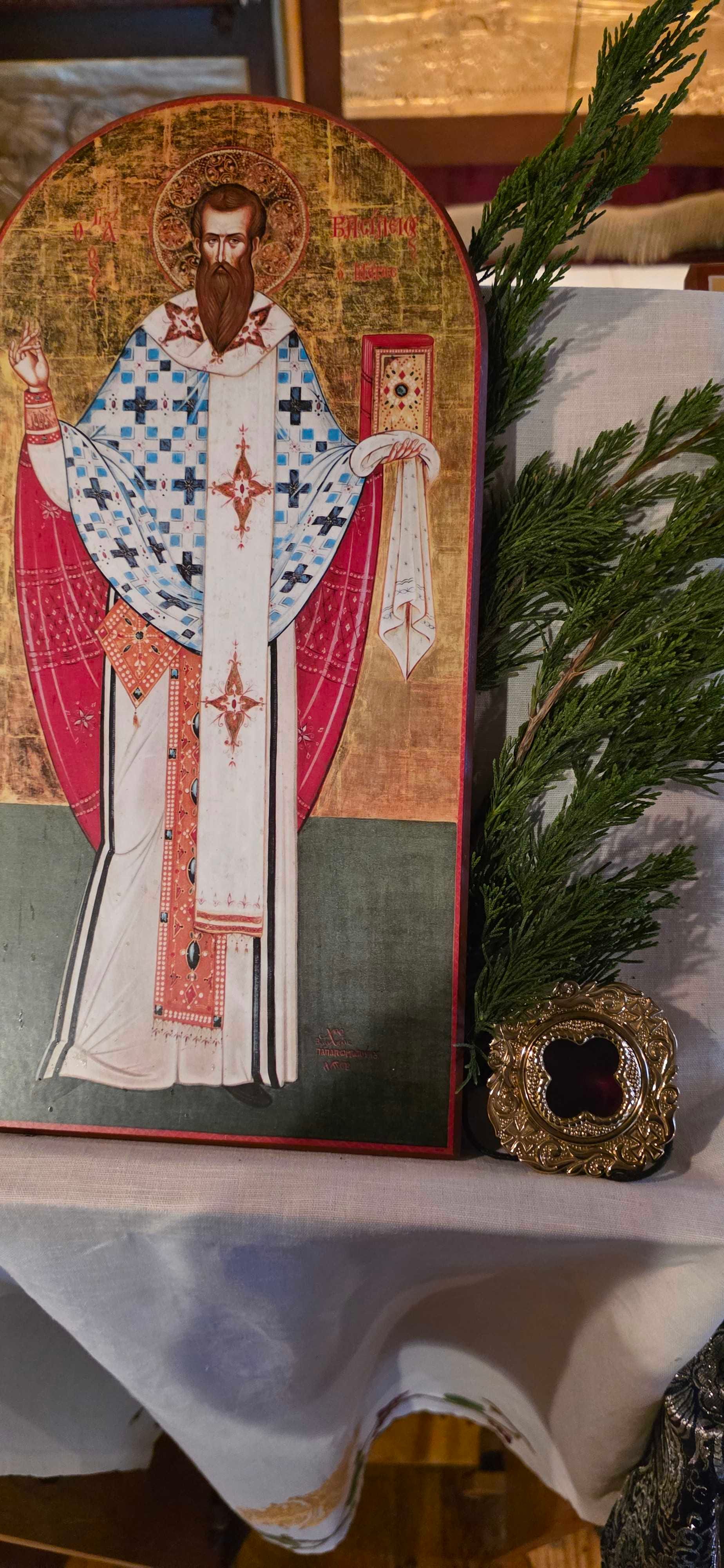
The reliquary next to the icon holds a piece of Saint Basil the Great from the 4th century AD. I forgot to ask what part of him this was.
The Theological Context: Why These Relics Mattered
In the late 4th century, relic veneration was still being defended against critics. Vigilantius of Calagueros (c. 406) would soon attack the practice as idolatrous; Jerome would respond vigorously in Contra Vigilantium. But already in the 370s–380s, the Cappadocian Fathers themselves—Basil, Gregory of Nazianzus, and Gregory of Nyssa had laid the theological groundwork for the practice. They argued that:
The bodies of the saints, having been temples of the Holy Spirit, retained a sacred character even after death.
Honor shown to relics was honor shown to Christ, who dwelt in the saints.
Miracles at tombs were proof of continued intercession.
Basil himself, in his Homily on Psalm 115, had defended the veneration of martyrs’ relics, saying: “Those who touch the bones of a martyr participate in the holiness that resides in them.”
Thus, the same generation that produced one of the most revered corporeal relics (Basil’s own body) also witnessed the explosive growth of the most revered contact relic (the True Cross).
Legacy
By the year 400, fragments claiming to be from the True Cross were already enshrined from Britain to Persia. John Chrysostom (c. 390) could claim that “everywhere the fragments of the Cross are honored equally with the purple and the diadem.” Meanwhile, Basil’s tomb in Caesarea became one of the great pilgrimage centers of Asia Minor until the city’s destruction by the Sassanids in the 7th century scattered his relics even more widely.
Together, the wood of the Cross and the bones of the great Cappadocian bishop symbolize the two streams that would dominate medieval relic piety: the unique instruments of redemption and the ongoing sanctity of the Church’s heroic dead. In the 4th century, both were new, both were controversial, and both would shape Christian devotion for the next millennium.
If you made it to here, thank you for reading, and next time I will be sharing photos and Drone Footage from the Church I got to witness both Relics at. Thank you. For free subscribers, you will get articles, pictures, and drone clips. For paid, you will get the raw, unedited footage and a more personally edited footage of the places I visit.
That was quite an interesting read. Church history is a fascinating topic!