


Why the Same Story?
Convergence, Not Influence
I want to be clear about something. There’s no evidence that Shotaro Ishinomori knew anything about the Ottoman devshirme, the Janissary corps, Skanderbeg, Ballaban Badera, Sokollu Mehmed Pasha, or any of the history I’ve described. Zero evidence. I looked. I don’t think he was drawing on Ottoman history. I don’t think there’s a chain of influence connecting Ishinomori’s studio in 1970 to the Sultan’s court in 1450.
This isn’t an influence argument. It’s a convergence argument. And the convergence argument is stronger.
Two completely unrelated systems of imperial subject-creation, separated by five centuries and six thousand miles, produced the same story. The same sequence: seizure, erasure, remaking, deployment, escape, rebellion. The same spectrum of outcomes: loyalty, failed resistance, internal subversion, defection, revolt, seizure of power. The same climax: the state trying to destroy what it made when the creation proves uncontrollable.
The stories converge because both systems begin with the same act: treating a person as raw material. The details are different. The structure is close enough to expose the same weakness.
The Logic
Any system that (1) seizes people from outside itself, (2) erases their prior identity, and (3) remakes them as instruments of its own power contains a built-in vulnerability. The remaking might be incomplete. The instrument might retain enough of its prior self to refuse. And the system can’t easily hedge against this, because the same process that makes the instrument powerful is the process that makes the instrument dangerous if it turns. A Janissary trained to be the finest soldier in Europe is also, if he defects, the finest soldier fighting against the empire. A cyborg built to be Shocker’s most lethal weapon is also, if he escapes, the most lethal threat Shocker faces.
The system can’t produce weak weapons. Weak weapons are useless. But strong weapons, if they turn, are existential threats. The better the system is at its job, the worse the consequences when the job fails.
This is a structural feature of empires that manufacture soldiers from stolen subjects. Not a bug. A load-bearing design flaw. The devshirme had it. Shocker has it. Any system built on this model will have it, because the vulnerability is baked into the logic.
The Image That Doesn’t Erase
Political and structural analysis gets you most of the way through this parallel. The mechanical argument holds. But the Neomartyrs break the mechanical explanation.
Structural analysis can explain Skanderbeg. He defected before the final step, retained memory of who he was, had the military capability to act on it. You can explain that as incomplete conditioning. You can explain Sokollu as ethnic solidarity, or the ordinary human drive to preserve what you came from. Patrona Halil, the Köprülüs, Kabakçı Mustafa. All explainable in political and psychological terms.
The Neomartyrs are harder. The process finished. The conditioning completed. There’s no political incentive to recant publicly. It means death. There’s no escape, no war. Just a person who had been living as something the system made them, and one day decided they weren’t, and said so out loud.
Aristotle argued in De Anima that the soul is the form of the body, not a substance added to it but the body’s organizing principle. The rational soul, the nous, isn’t a product of conditioning. It’s the thing doing the processing, the thing that orients and decides. You can alter circumstances. You can layer new habits over old ones. But the form persists. It goes quiet. It waits.
Plato’s argument is related but sharper. The soul has a natural orientation toward the Good. Not the good defined for it by the Sultan, not the good Shocker’s scientists approved. The Good itself, which no institution gets to assign. Coercion can redirect the soul’s attention, make it look the other way, train it to perform against its own nature. But the appetite for its true end doesn’t get trained out. The allegory of the cave makes it concrete: a person who has glimpsed the light, even briefly, even in some half-remembered childhood before the officials arrived on horseback, can’t be permanently satisfied with shadows.
Start with Part I: The Collection.
Then read Part II: The Weapon.


The Eastern Church synthesized both of these and went further. The eikon isn’t only a philosophical concept. It’s a theological reality. God made every person in his image, and that image is what makes resistance possible at the deepest level. Not political will, not military training. The image. The thing that no production line can reach, that no decade of conditioning can fully overwrite, that asserts itself in the Neomartyr who walks out into a public square and says “I am Christian” knowing exactly what comes next.
Ottoman history supplies cases that test that claim. Across centuries of forced recruitment and identity change, it still produced defectors, internal subversion and public reversals. Not because every subject resisted. Most did not. The point is that the process never guaranteed complete ownership of the person inside it.
Ishinomori’s Postwar Context
Ishinomori was born in 1938 in Tome, Miyagi Prefecture. He was seven years old when Japan surrendered. He grew up in the rubble of an empire that had, within living memory, done its own version of this same thing: conscripted its citizens, indoctrinated them in the ideology of kokutai (the national body), remade civilians into soldiers who were expected to die for the Emperor.
I’m not going to overclaim this. I don’t know what Ishinomori was thinking about when he created Skull Man and Kamen Rider. I don’t have diary entries or interviews where he says “I based Shocker on the Imperial Japanese military” or “I was thinking about the devshirme.” But he was a Japanese man born in the late 1930s, writing in the early 1970s, and the thing he kept writing about, the story he told over and over, was: a state kidnaps a person and remakes him into a weapon, and the weapon escapes.
Japan had direct experience with that machinery. The whole country did. Every family that sent a son to the Imperial Army knew some version of it. The state takes your child. The state remakes your child. The state sends your child to die.
That context helps explain the convergence. Ishinomori and the Ottoman devshirme produced the same narrative because they were both describing systems of imperial subject-creation. Different empires, different centuries, different methods. Same logic. And the same logic produces the same story, because the story isn’t about any particular empire. The story is about what happens when power tries to eat people and turn them into instruments, and what it looks like when one of them gets free.
The Weapon Remembers
November 28, 1443. Krujë. Skanderbeg raises the double-headed eagle of his family over the fortress walls. He took the city with a forged Ottoman letter and a lifetime of Ottoman military training. His brother’s killer, maybe. His father’s pride, maybe. A warlord who would spend twenty-five years bleeding the empire that built him. They called him Iskander Bey, Lord Alexander, and the name they gave him became the name that haunted them.
Istanbul. Sokollu Mehmed Pasha, Grand Vizier of the Ottoman Empire, born a Serbian Orthodox boy in Herzegovina, signs the order restoring the Serbian Patriarchate of Peć. He installs his own cousin as Patriarch. He does this using the full authority of the office the devshirme gave him. The imposed identity funding the survival of the erased one.
Krujë again. Ballaban Badera, born Michael, son of Mark, dies outside the walls his brother defends from within. A hunter named Gjergj Aleksi shoots him through the neck. The conversion held. Michael never came back. The system won that one.
September 1730. Istanbul. Twelve thousand Albanian Janissaries storm the capital. Patrona Halil forces a Sultan off his throne. Two months later, the new Sultan has him killed. The creation was too dangerous to leave alive, even after it did what the state wanted.
June 15, 1826. Istanbul. Mahmud II fires on the Janissary barracks. Six thousand dead. The empire dismantling the army it spent four centuries building out of stolen children, because the children grew too strong.
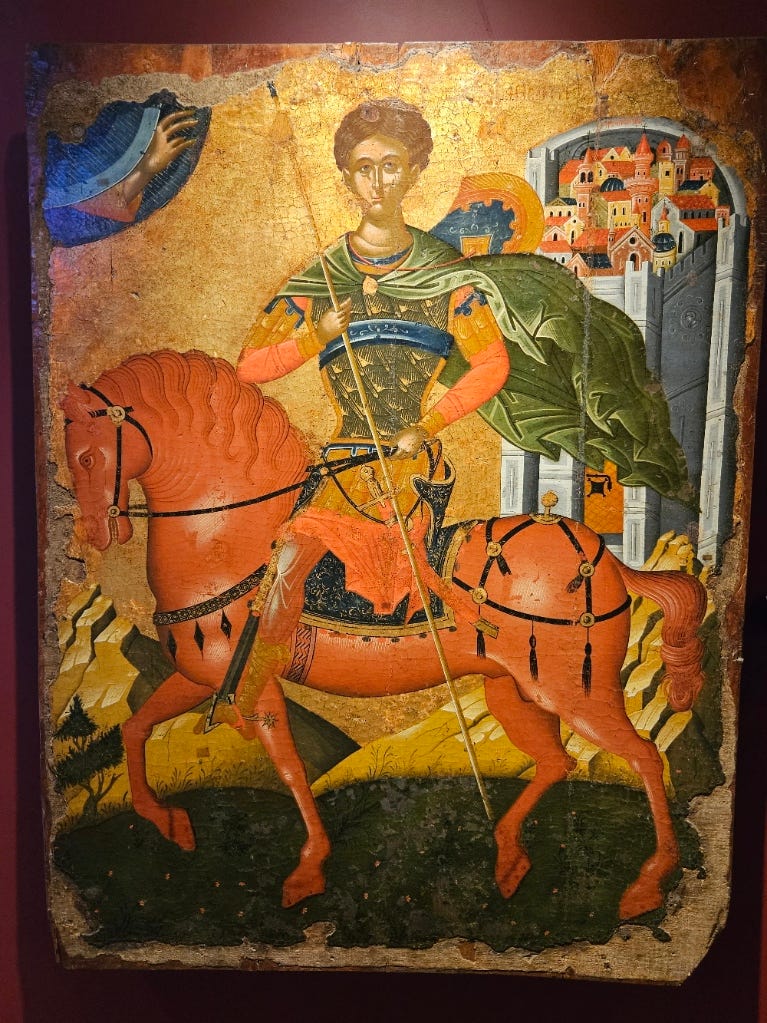
Constantinople. A man named Demetrius, living as a Muslim for years or decades, walks out into a public space and announces that he is Christian. He knows what happens next. The Ottoman court executes him. The Orthodox Church declares him a saint. There was no tactical calculation in what he did. No escape route, no guerrilla campaign, no twenty-five-year war. Just the image asserting itself, past all the conditioning, past everything the system spent years installing.
April 3, 1971. A Japanese television screen. A college student named Takeshi Hongo, surgically altered into a grasshopper cyborg by a global terrorist organization called Shocker, escapes before the brainwashing can take. He looks at the body they gave him, this monstrous rebuilt thing, and he decides to use it against them. He puts on the mask. He fights.
Different centuries. Different continents. Different bodies carrying the marks of different empires.
The same crack in the system. The place where the remaking failed. The ten percent that didn’t take. The will that survived the surgery, the conversion, the renaming, the decade of training, all of it designed to produce an obedient weapon, and somehow the person inside held on.
Five hundred years of Ottoman history couldn’t close that crack. Fifty years of Kamen Rider franchise storytelling keeps returning to it, episode after episode, series after series, because the story refuses to be finished. The weapon keeps remembering. The weapon keeps turning.
And the empire, whatever empire, in whatever century, on whatever continent, keeps learning the same thing the hard way: you can remake the body. You can bury the name. You can kill the god and teach a new language and train the hands to hold a sword for your wars.
The Church Fathers said you can’t destroy the eikon. The Ottoman Empire tested that for four centuries and never succeeded. Ishinomori wrote the same answer in manga and then in a children’s television show.
You can’t always get the last ten percent. And that’s enough.
That's the series. If it earned your time, share Part I — that's the entry point, and it's free. If you've been reading along without subscribing, now's the time. And if you want to support work like this, a paid subscription keeps it going.
God Bless. — George