

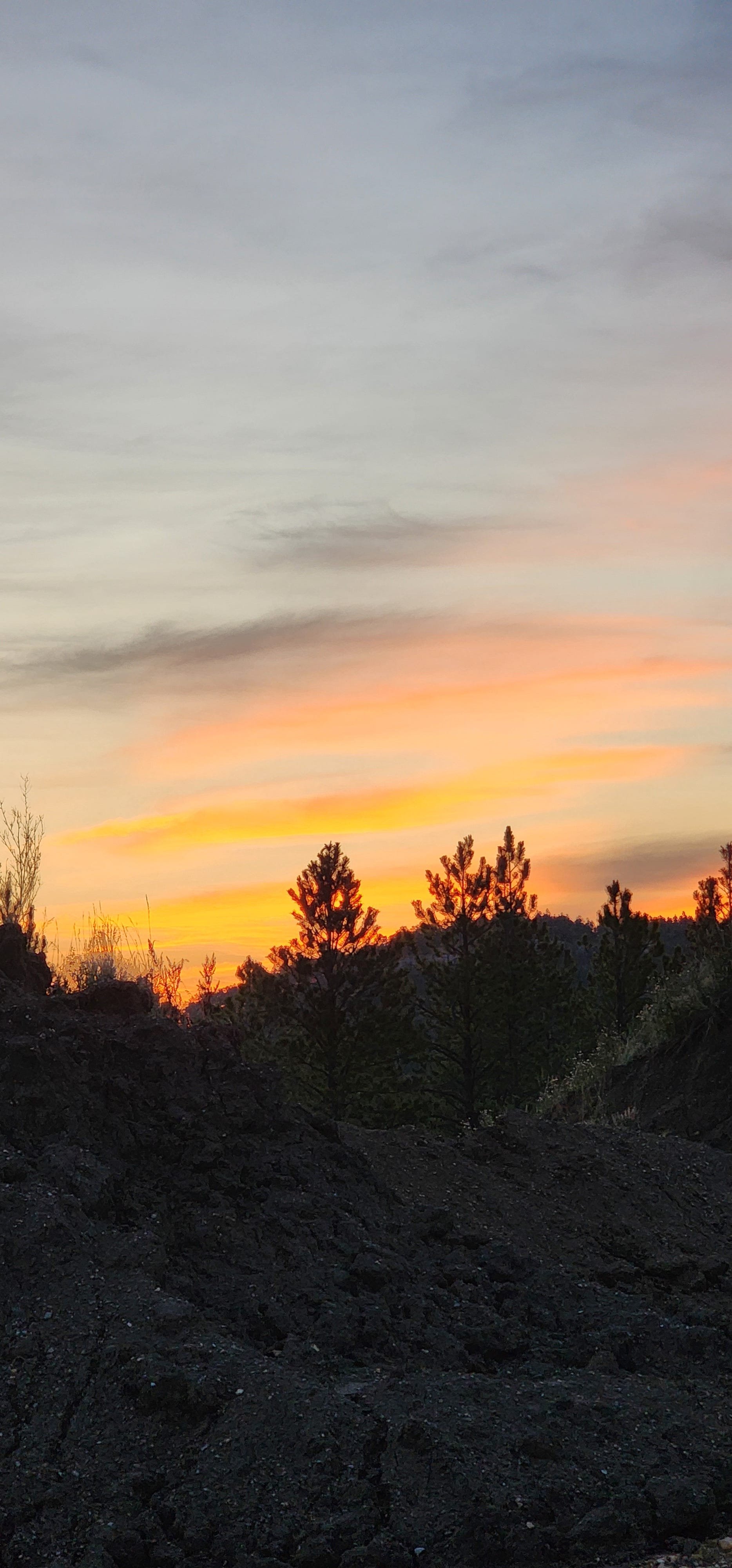
I pulled off on Tatanka Hill at 5:47 AM on August 22nd.
Still dark. Pines were black shapes. The sky was doing something orange and violent behind them. That particular color that looks fake in photos but lands different when you’re standing at 4,500 feet with nobody else around and you can smell the pine and the dirt and the cold air all at once.
I took a picture.
Then I thought: “I need to fly here. Wish I had a drone.” The Idea was planted.
Aug 22, 2024 · 5:47 AM
Fire sunrise over Tatanka Hill. Orange and yellow burning behind silhouetted pines, dark mine tailings and fresh-turned earth in the foreground.
Tatanka Hill sits just north of Deadwood on Highway 85. Kevin Costner founded Tatanka: Story of the Bison there after filming Dances With Wolves. Fourteen larger-than-life bronze bison run ahead of Native American riders across the high prairie hill overlooking the gulch.
I know that hill. I worked it.
From July 28th, 2024 to February 1st, 2025, I was up there every day on the site directly across from the museum, where the new Lawrence County Law Enforcement Center now stands. Six months of early mornings, cold starts, and a sky that never looked the same twice. Before the crews showed up, before the equipment warmed up, I was standing on that cut hillside watching the Black Hills do what they do at first light.
Nobody talks about that part of a job. The part where you show up before sunrise and the whole place belongs to you for about twenty minutes.


Four months of photos. Same hill. You’d never know it was the same place.
That’s the Black Hills. They don’t repeat themselves.
The Gulch
Deadwood sits at the bottom of a gulch carved by Whitewood Creek. You don’t see the town until you’re basically in it. The hills close in, the canyon narrows, and suddenly there’s a Main Street and a Starbucks and a casino and a sign that says someone got shot here in 1876. The sign is on a brick building. The brick building has a FedEx drop box in the lobby.
That’s Deadwood.
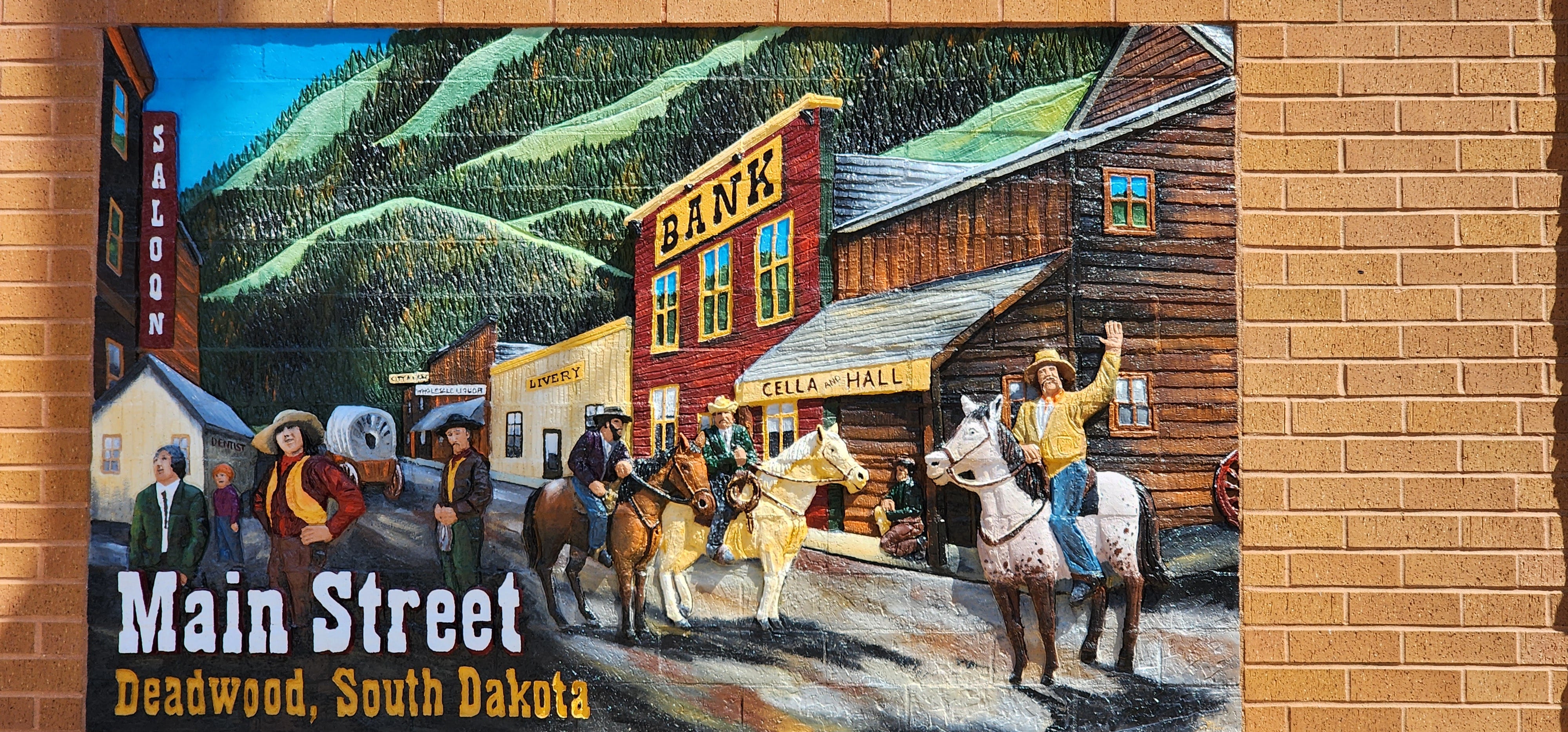
The name came from a party of miners in 1875. They came through a gulch full of dead trees and called it Deadwood Creek. Practical. No poetry. The Lakota had been calling this place Owáyasuta, which means “to approve or confirm things,” for considerably longer. The Fort Laramie Treaty of 1868 was supposed to protect it. It died the same way Wild Bill did. Somebody snuck up from behind.
Gold. Custer’s 1874 expedition found it on French Creek. Word got out. By 1876 the gulch had 5,000 people. By 1877 it had 12,000. No law, no government, no real claim to the land at all. Just men digging, saloons selling, and a whole economy running on gold dust and bad decisions.
July 28th, First Week on the Hill
A summer storm came through on July 28th and dumped rain on Main Street for about forty minutes. That was my first week on the hill. When the storm stopped, a rainbow came up over the canyon wall and arched directly over the casino storefronts. The wet pavement reflected everything back. Rock boulders sat in puddles in the median. The kind of boulders you only see in a median because someone blasted them out of a hillside to build a parking lot. Ponderosa pines on the ridge were still dripping.
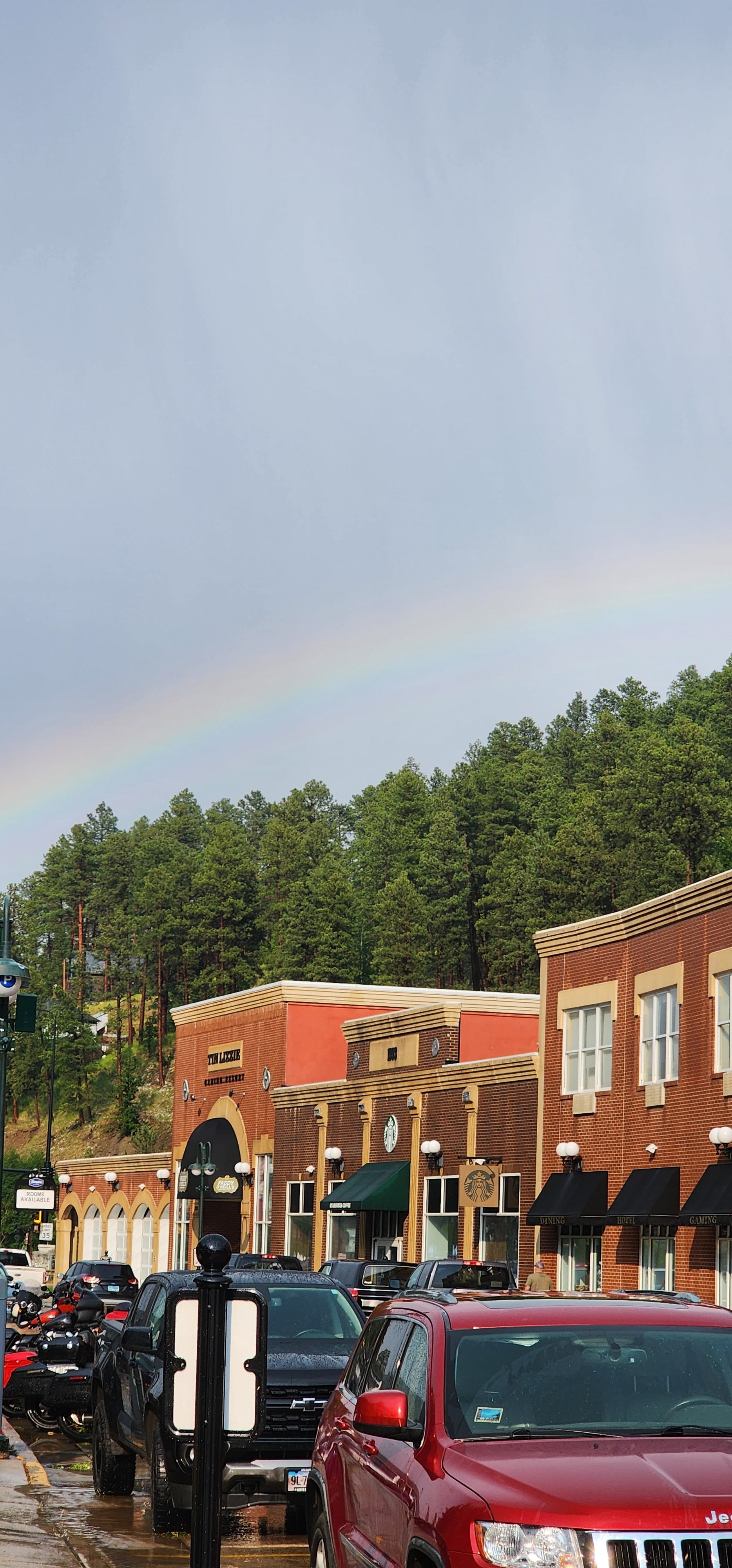
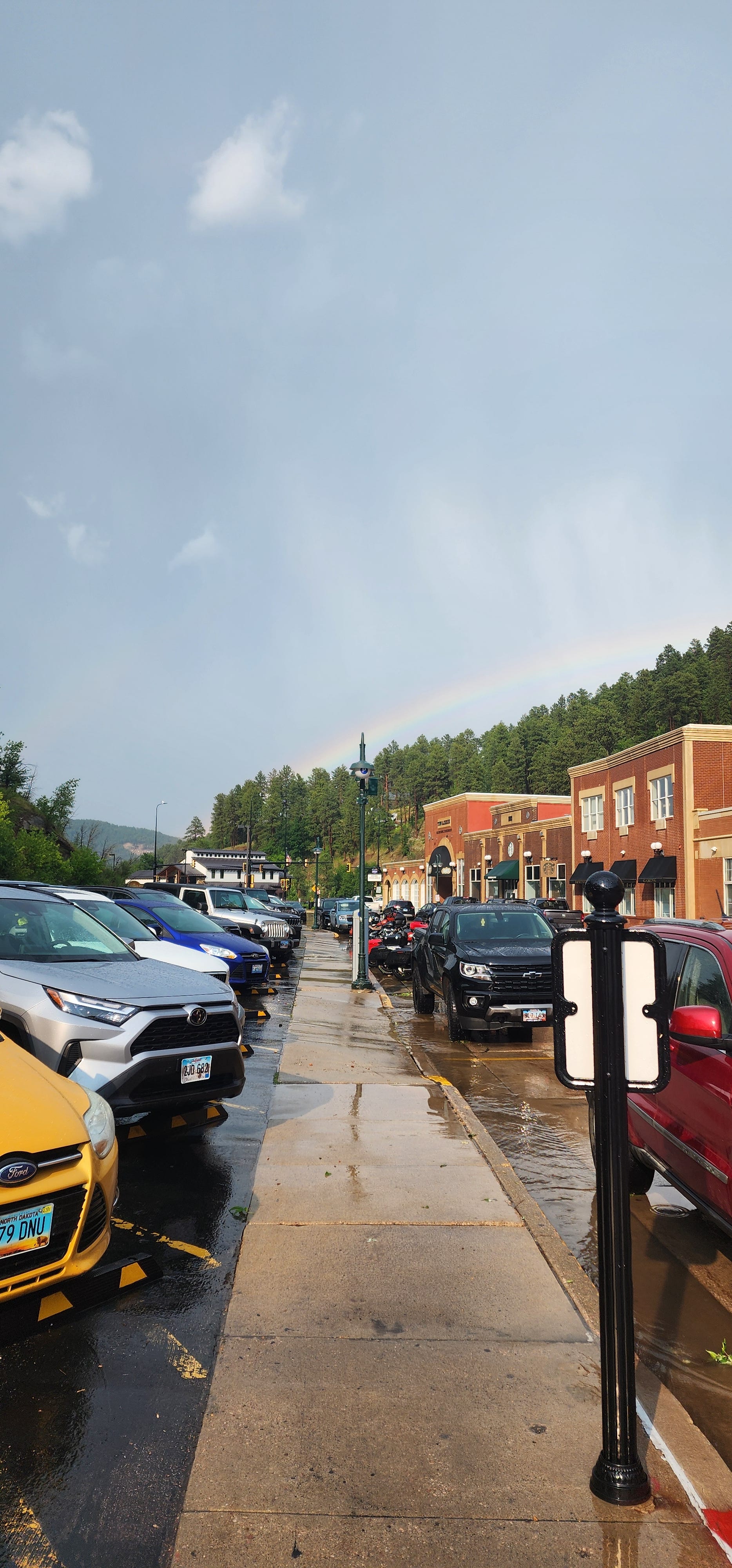
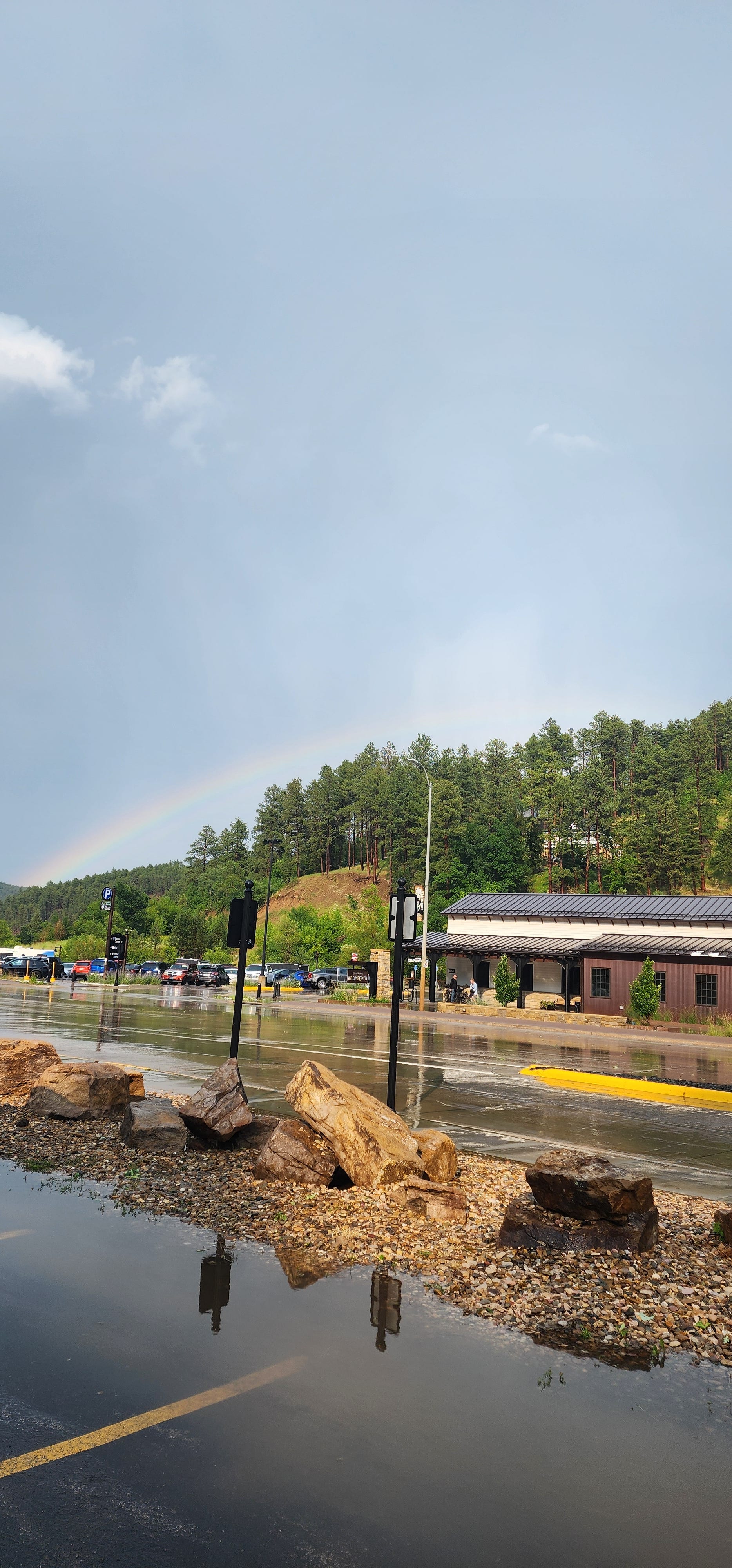
Deadwood always does this. Gives you something gorgeous and then puts a slot machine in front of it.
Main Street, August 16th
Wild Bill Hickok showed up in Deadwood looking for fortune in the summer of 1876. Three weeks later Jack McCall walked up behind him on August 2, 1876 and shot him in the back of the head at Nuttal and Mann’s Saloon. Hickok was holding aces and eights. They still call that the Dead Man’s Hand. McCall got caught about a block away. There’s a sign on Main Street marking exactly where. It hangs above a gift shop.
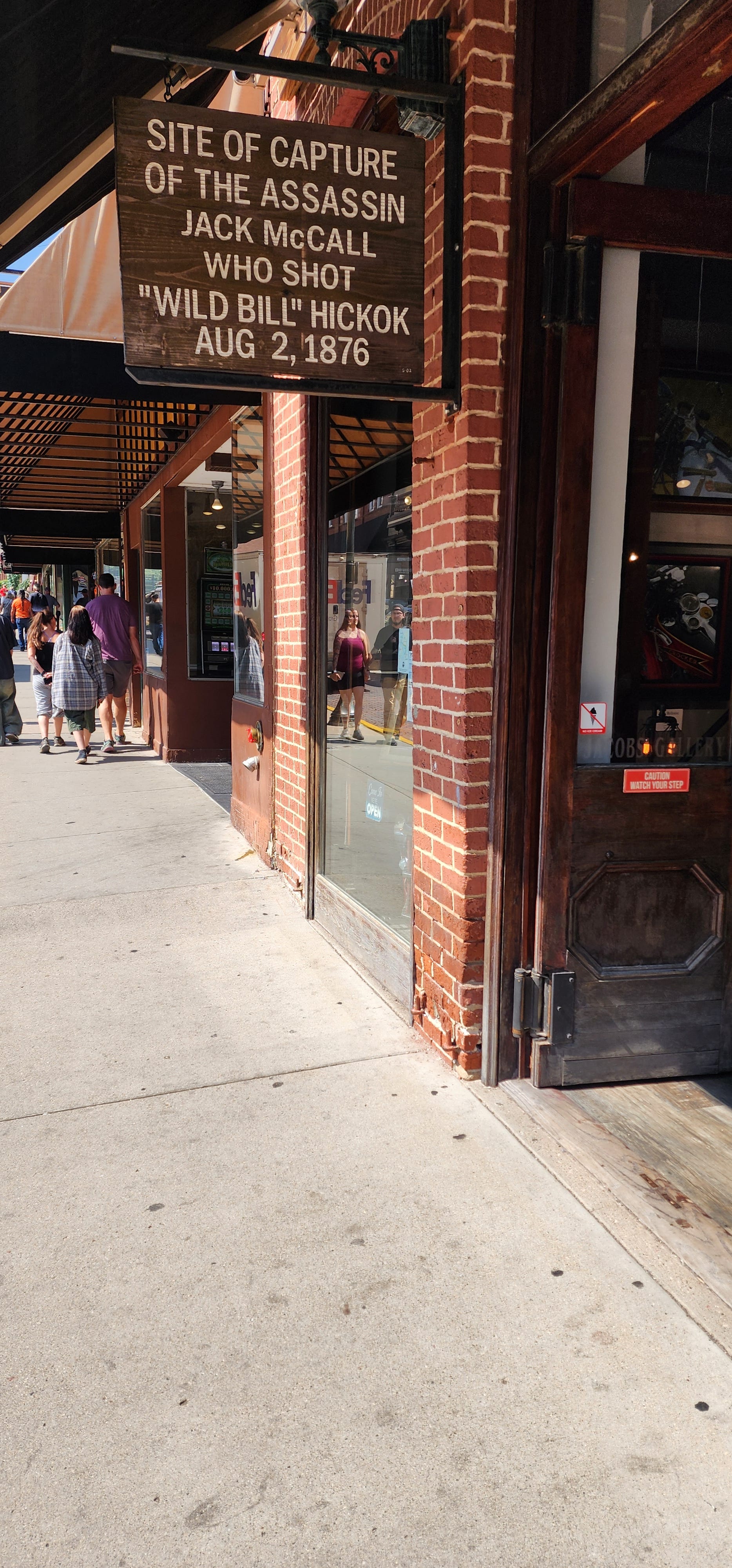
I stood there in August 2024 and read it twice.
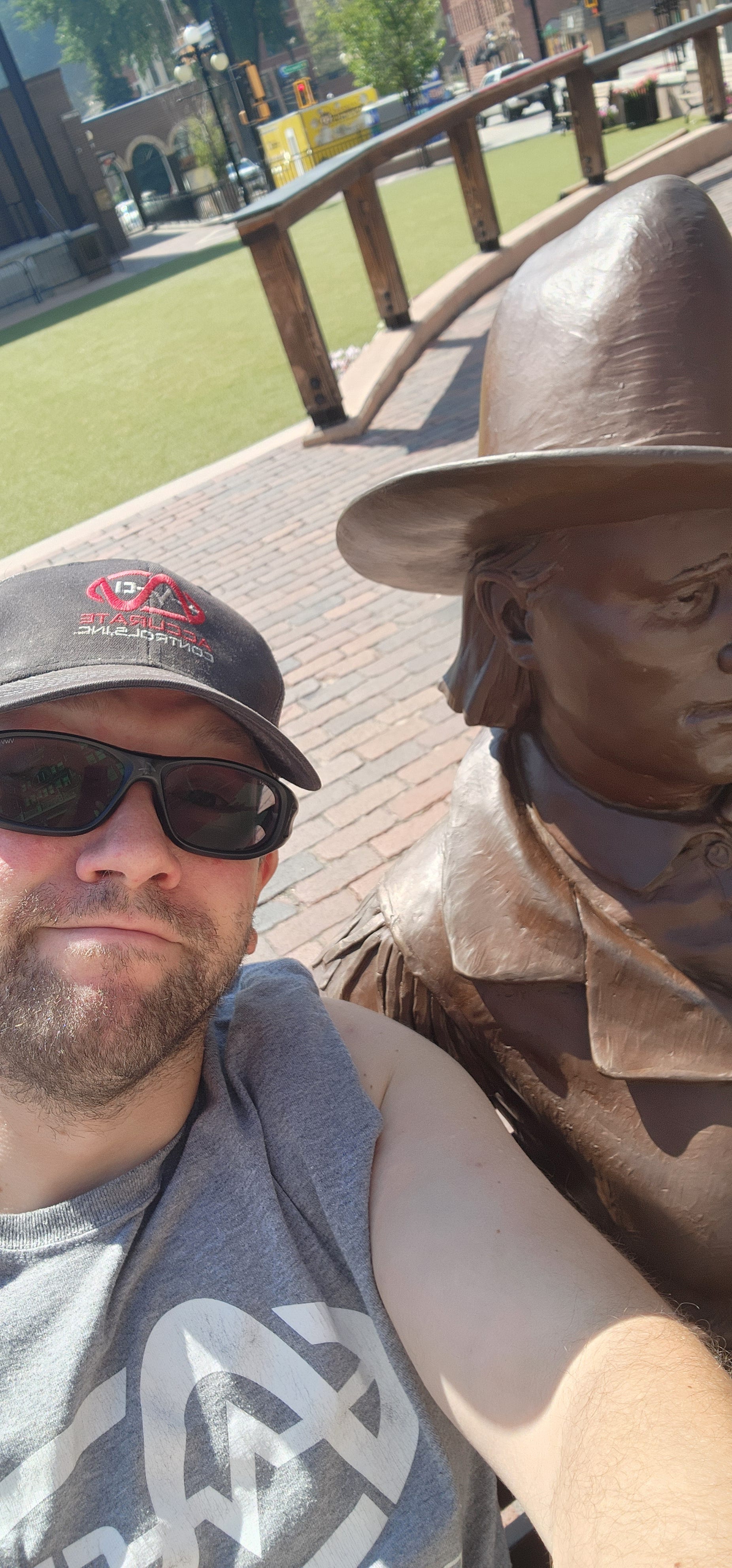
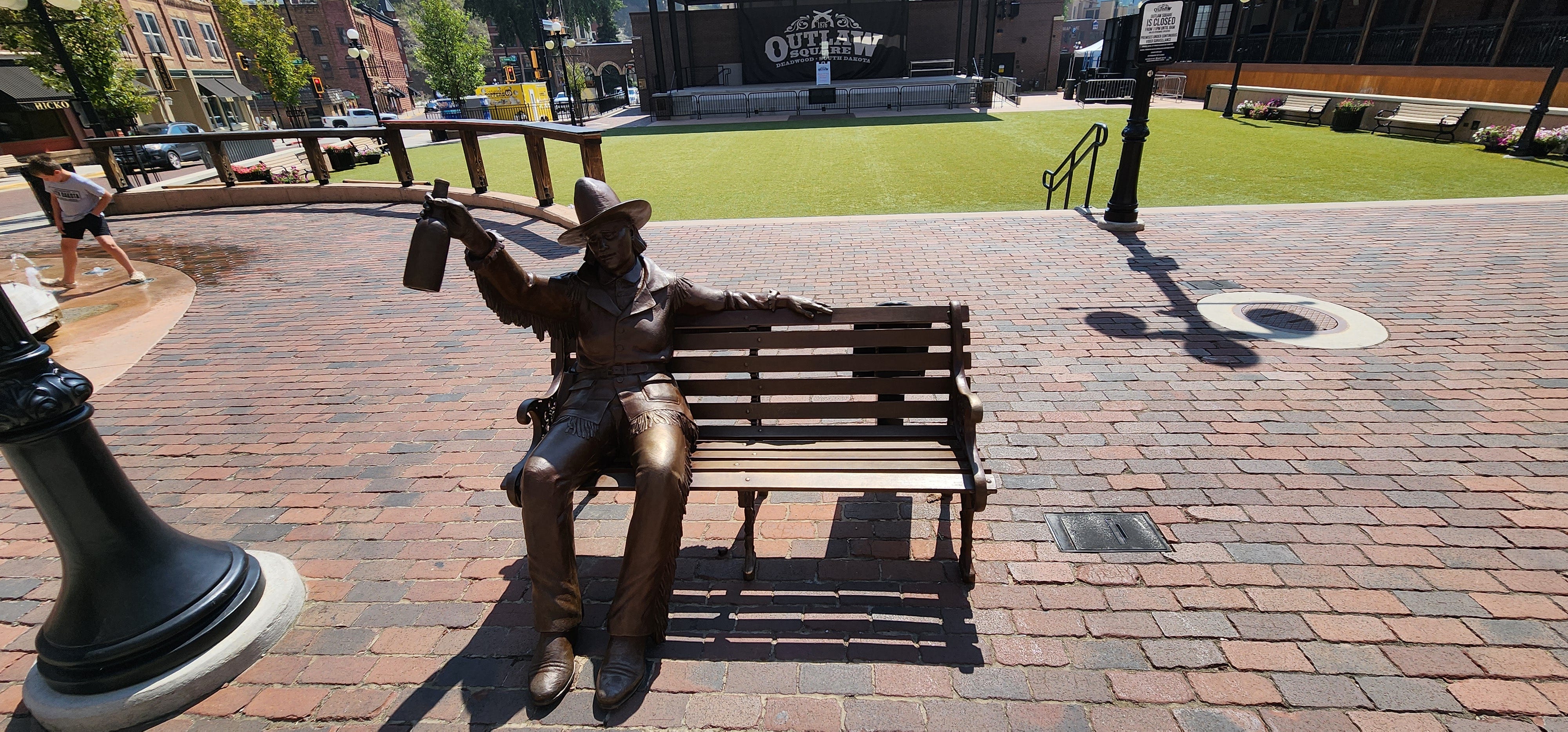
Calamity Jane is out there in Outlaw Square, bronze, sitting on a bench, holding a jug, fringe jacket spread wide like she owns the whole block. Martha Jane Cannary arrived in Deadwood in June 1876 in the same wagon train as Wild Bill. She outlived him by 27 years and ended up buried next to him at Mount Moriah Cemetery anyway.
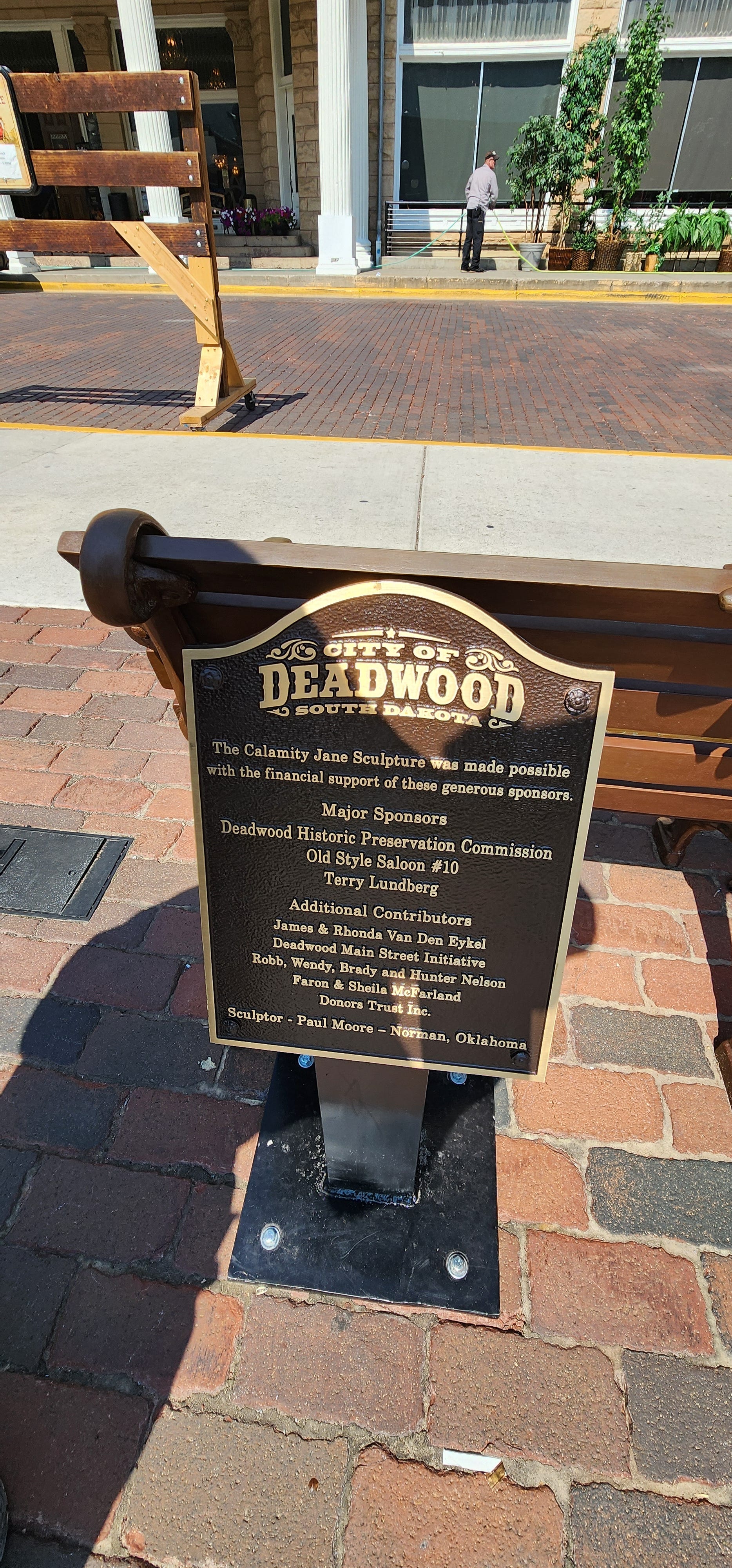
The plaque at the base says the sculptor was Paul Moore from Norman, Oklahoma. The Deadwood Historic Preservation Commission paid for it, with major sponsorship from Old Style Saloon #10. That’s the same saloon where Hickok was playing cards when he died. They’re funding statues of the people who drank there. I respect the hustle.
The Town That Refused to Die
The town burned three times. September 1879 took out more than 300 buildings, 1959 hit again, and December 1987 took the Syndicate Building. That last fire is what pushed South Dakota to put gambling on the ballot. The referendum passed in 1988. Cards were back on the tables in 1989. The town didn’t die.
It never has.
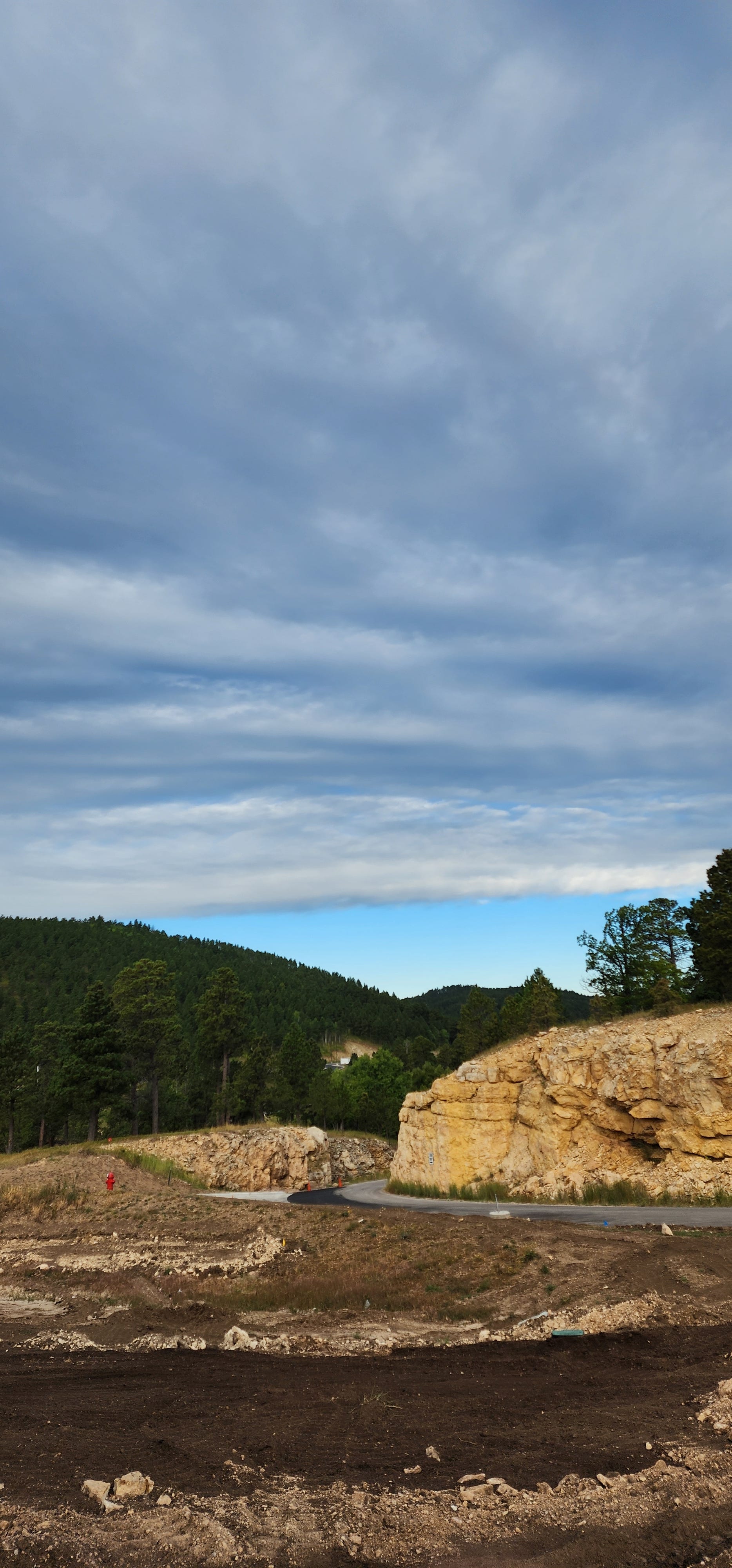
"Someone is always blasting through these hills for something."
The Rule at the Time
There’s one more thing worth saying straight.
When I was there, Deadwood’s local code designated protected airspace over the National Historic Landmark District as the “Deadwood Drone No Fly Zone.” The city removed that provision in April 2025 after South Dakota law changed. The FAA still controls the airspace, and pilots still have to follow federal rules.
I didn’t love it, but I respected the rule that was in place.
So every shot in this piece is from the hill. From the job site. From the road cuts and the ridgelines and the pre-dawn pull-offs where I stood with a phone and watched the sky do something that no drone could have improved on anyway.
Sometimes the restriction is the story. You can see the whole shape of a canyon from above without ever flying into it.
February 1st — Last Night
I walked into Saloon #10 on February 1st, 2025. My last night in Deadwood. Last shift on the hill. Last round with my co-worker.
Felt right.
I sat down at the bar. Canadian Wicket. 17% alcohol. Special Selection. Whatever that means. It was there and it was cold and it was Saloon #10 and six months of Black Hills mornings were ending in about eight hours.
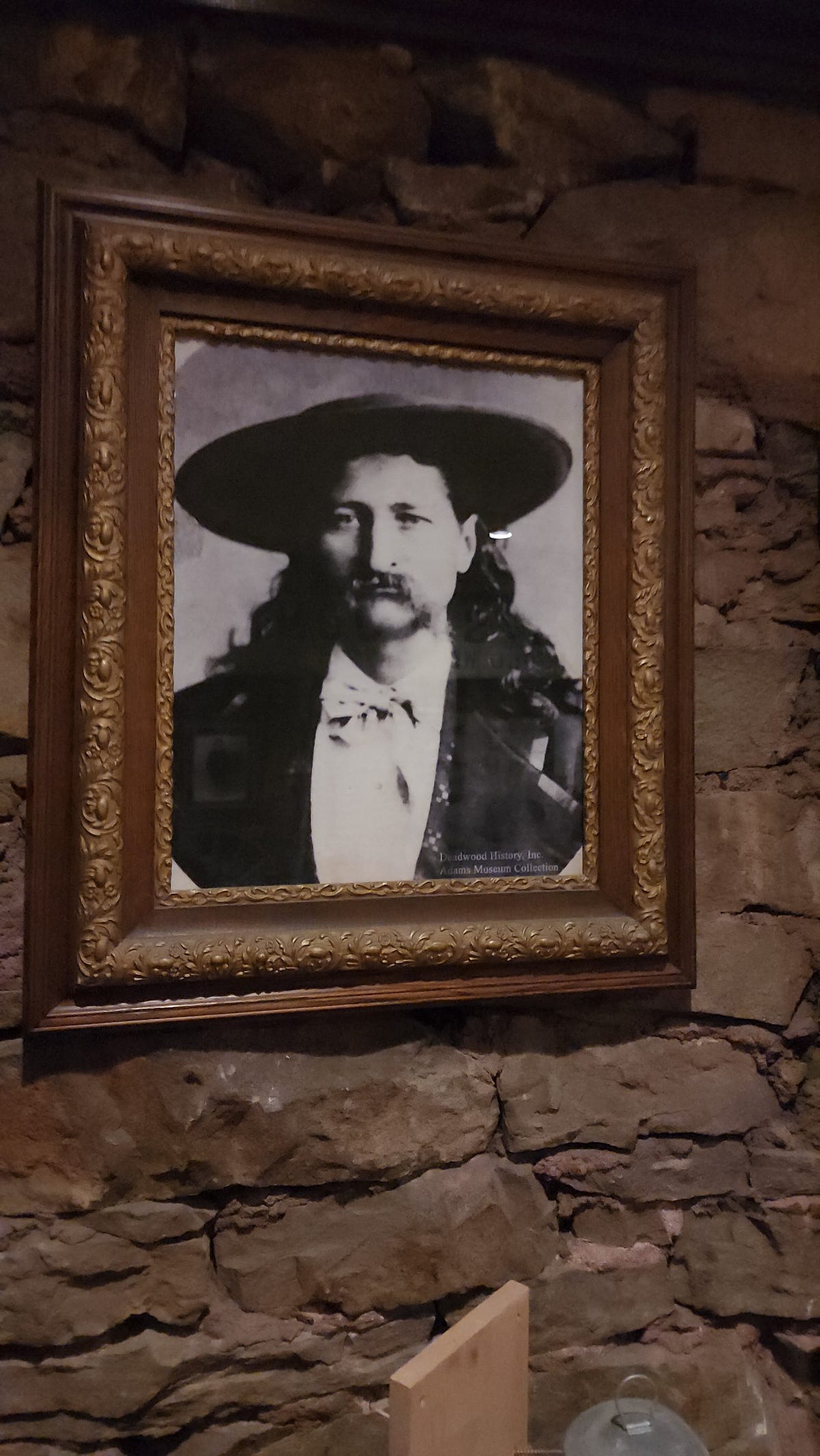
I drank it looking at Wild Bill’s portrait on the stone wall. He still doesn’t look impressed.
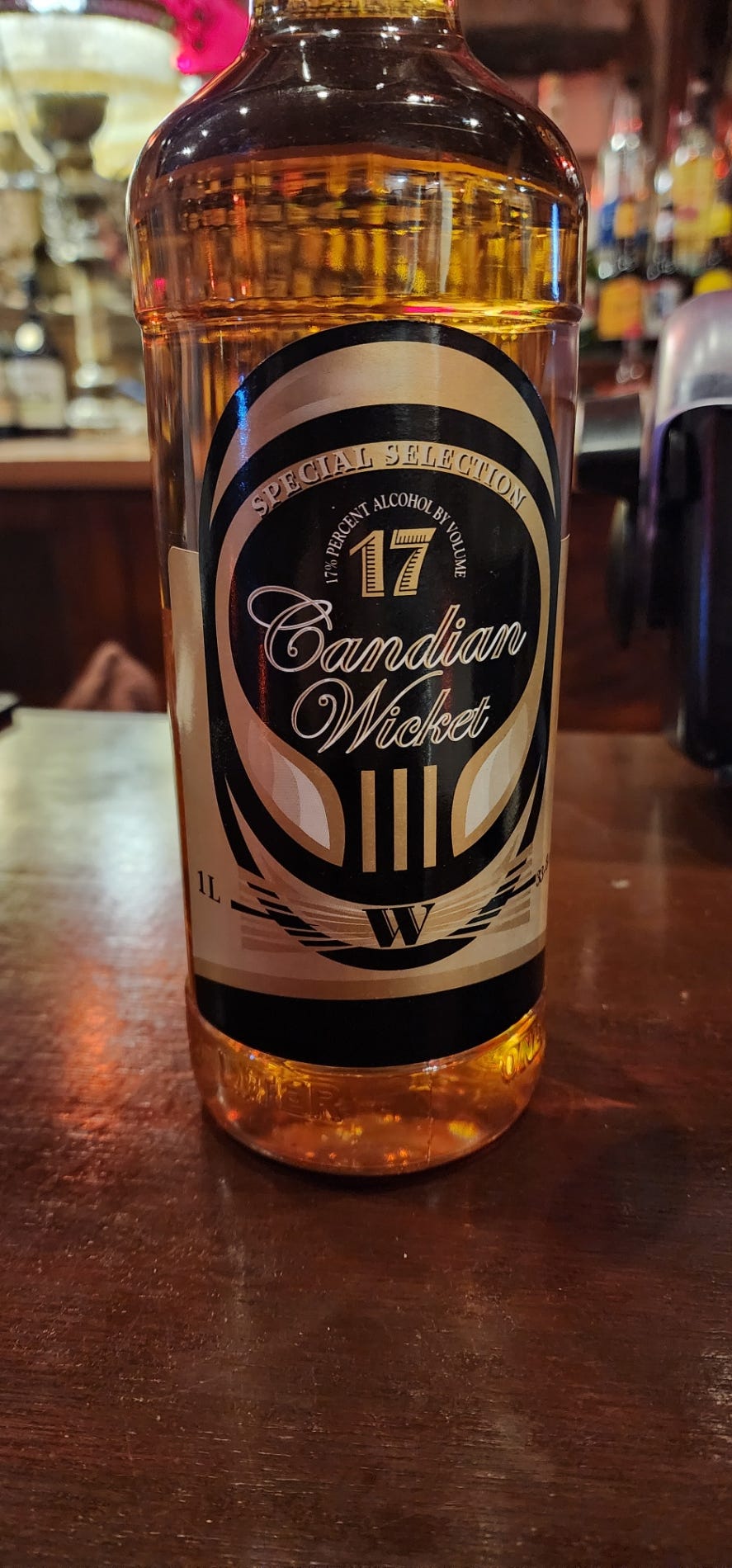
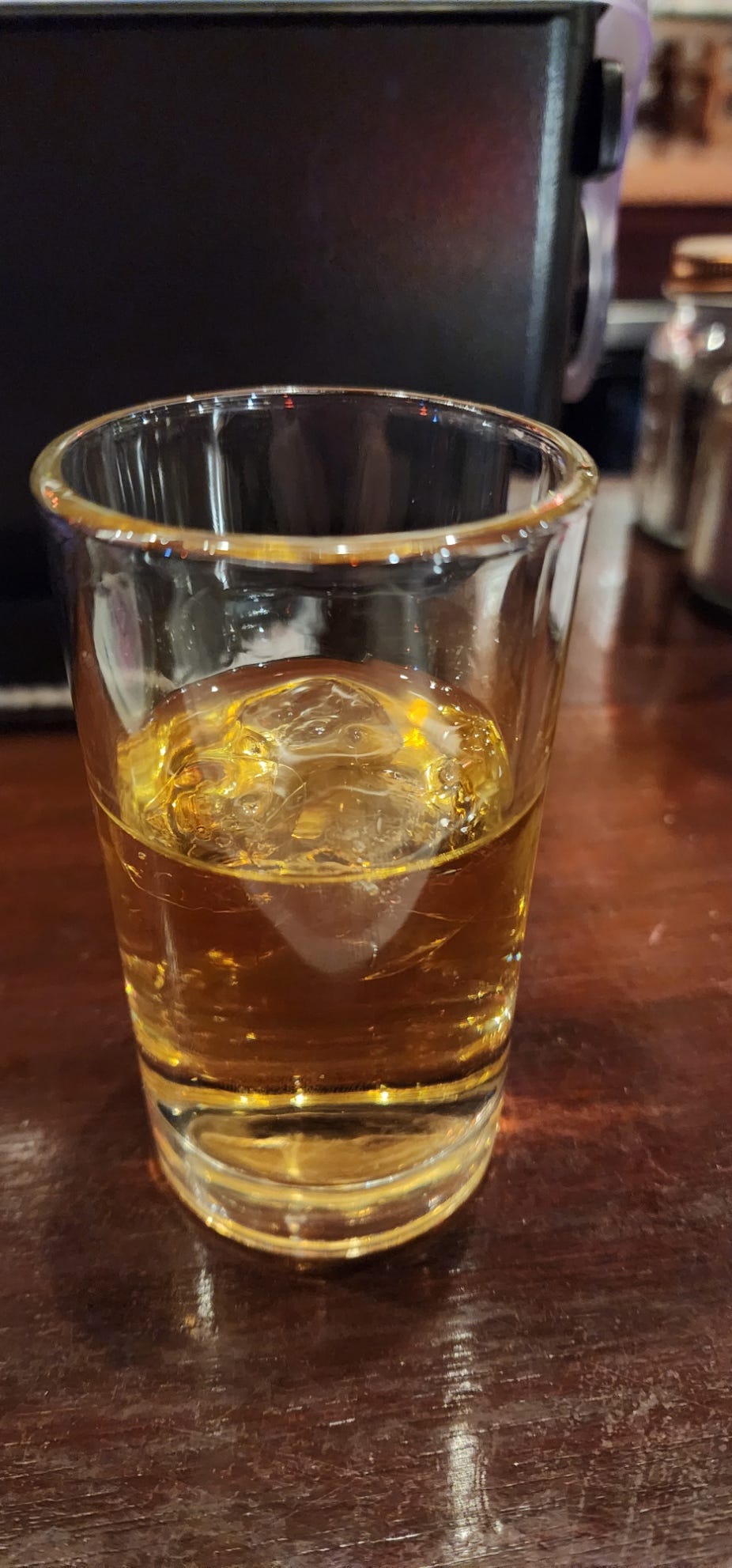
The Canadian Wicket was velvety smooth. I meant to pick up a bottle before I left and forgot. Oh well. That gives me one reason to go back. Then the bartender pointed me toward the stairs going down.
Downstairs
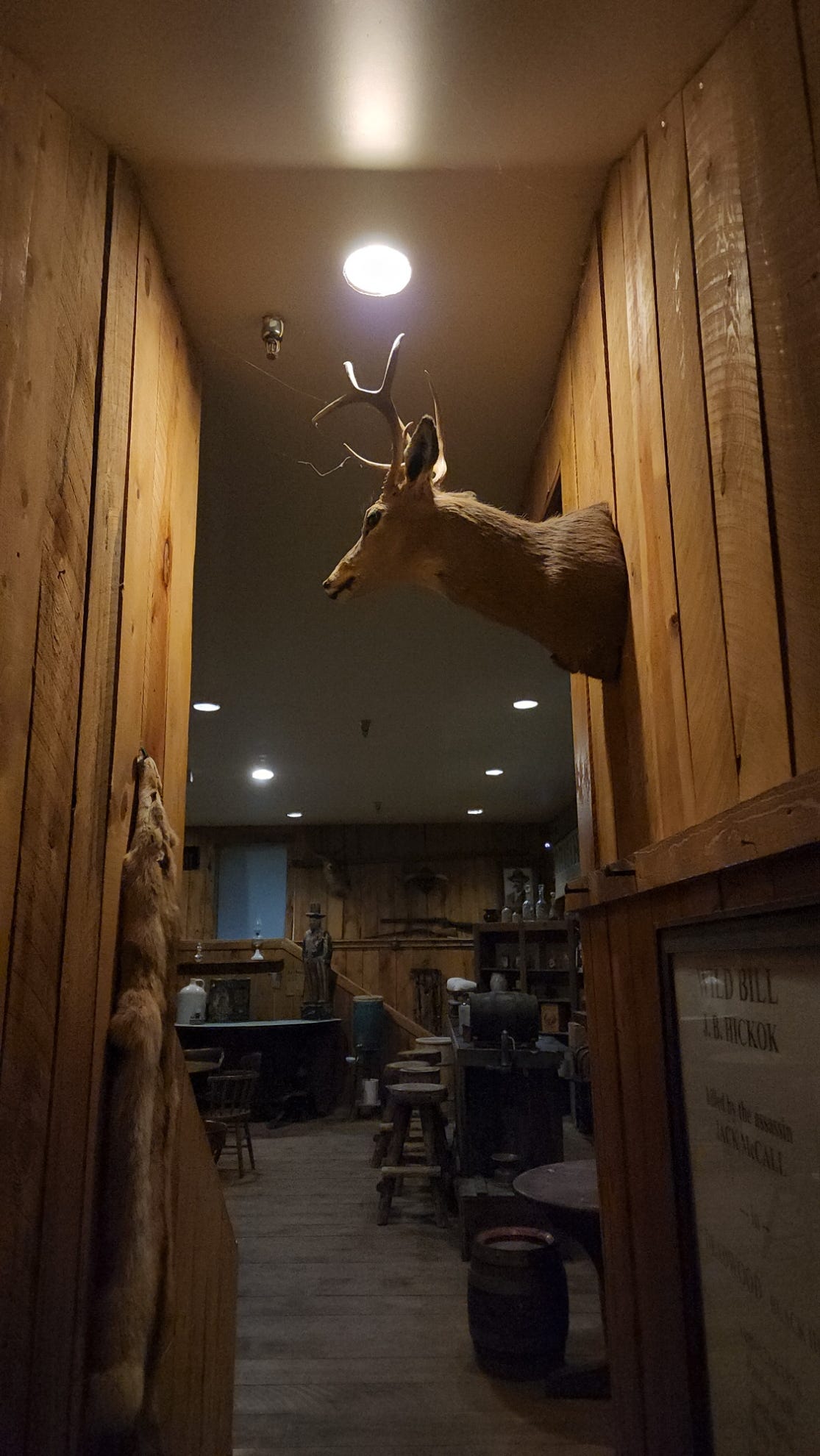
That’s where the real saloon is. Underground, stone walls, low ceilings, plank floors. The recreation of what Nuttal and Mann’s actually looked like in 1876 is down there in the basement, not up on the main floor with the barstools and the slot machines and the pressed tin ceiling. You have to go down to find it.
Which feels right. Deadwood buries its history but it doesn’t throw it away.
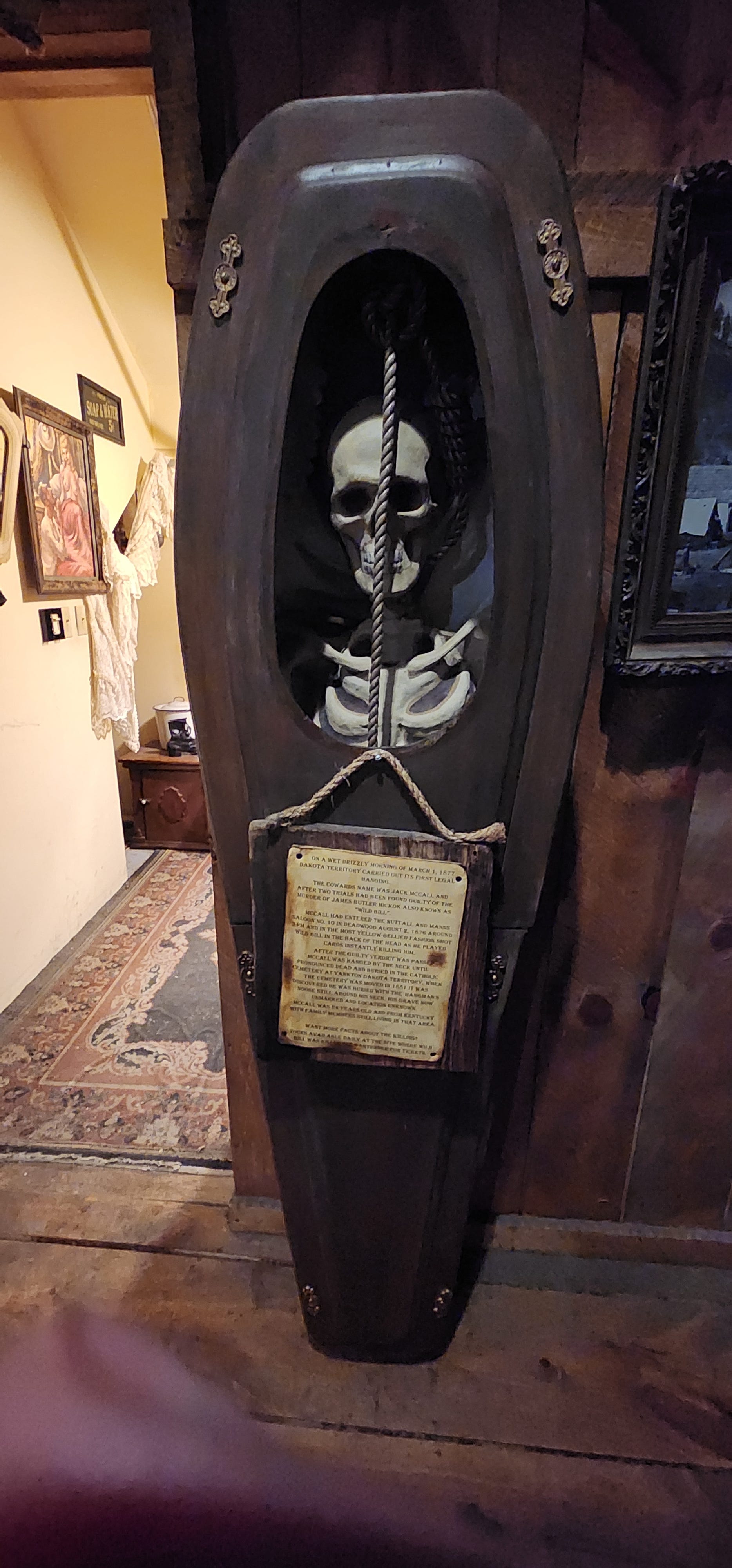
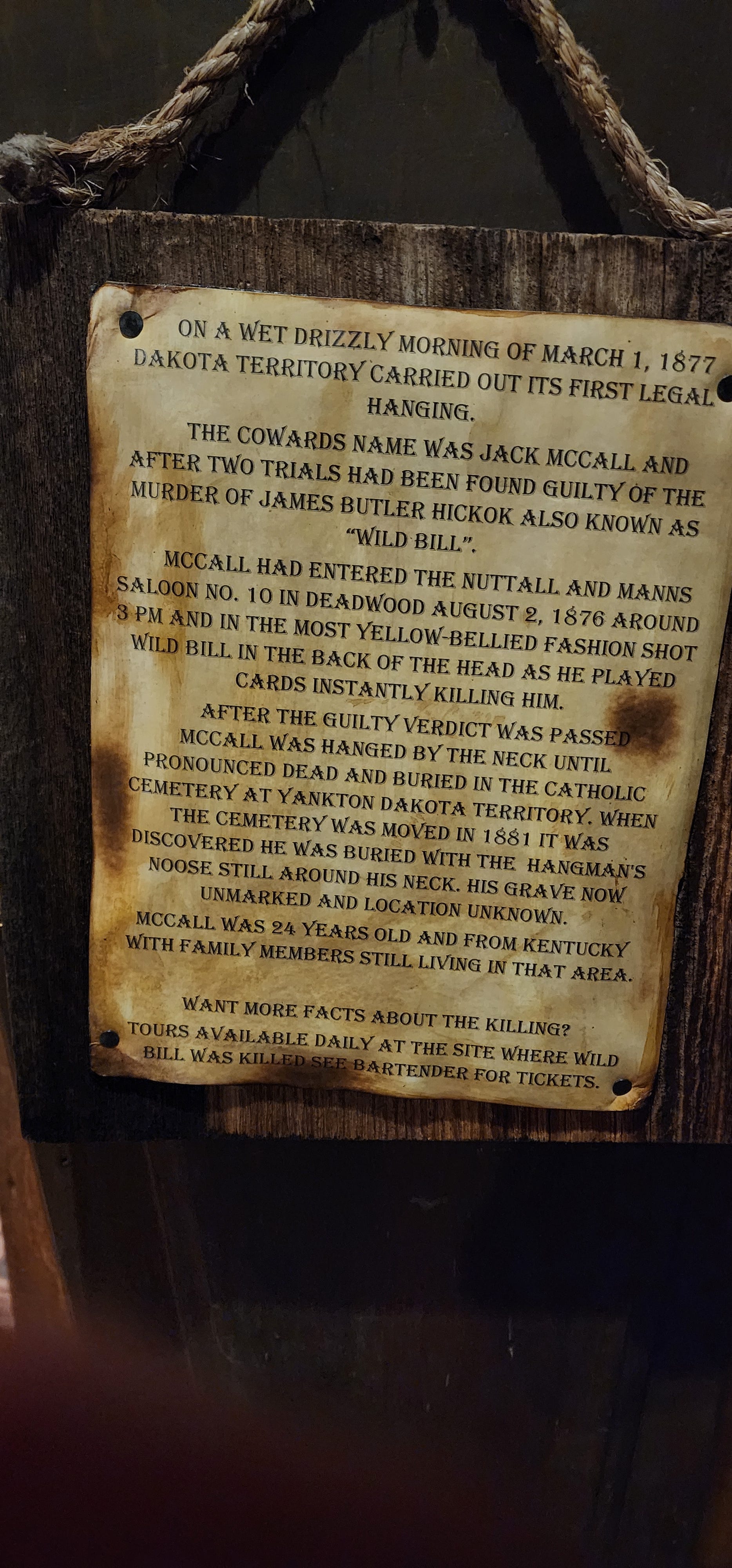
Near the entrance a coffin stands upright, skeleton and noose behind, with a plaque below that tells you exactly what happened. Jack McCall entered Nuttal and Mann’s Saloon No. 10 on August 2, 1876 around 3 PM and shot Wild Bill Hickok in the back of the head as he played cards. McCall was 24 years old and from Kentucky. On a wet drizzly morning of March 1, 1877, Dakota Territory carried out its first legal execution. When they moved the cemetery in 1881 they found McCall still buried with the hangman’s noose around his neck. His grave is now unmarked. Location unknown.
That plaque doesn’t hedge. I respect that.
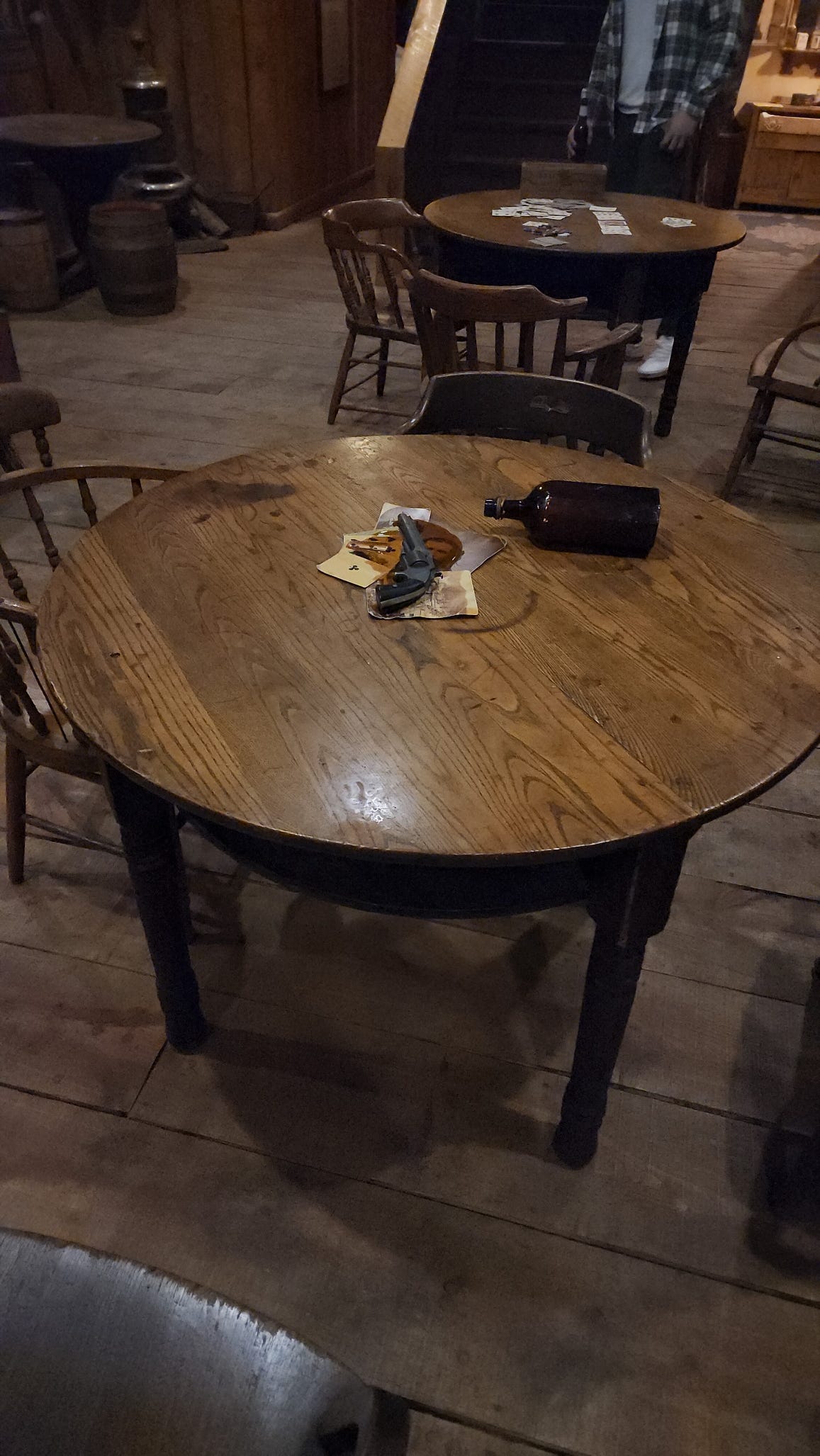
The card tables are still set up. Round wood table, chairs pulled out, cards laid down, a revolver sitting in the middle like someone just stepped away. A second table behind it, same setup. This is where it happened. Right here on this floor.
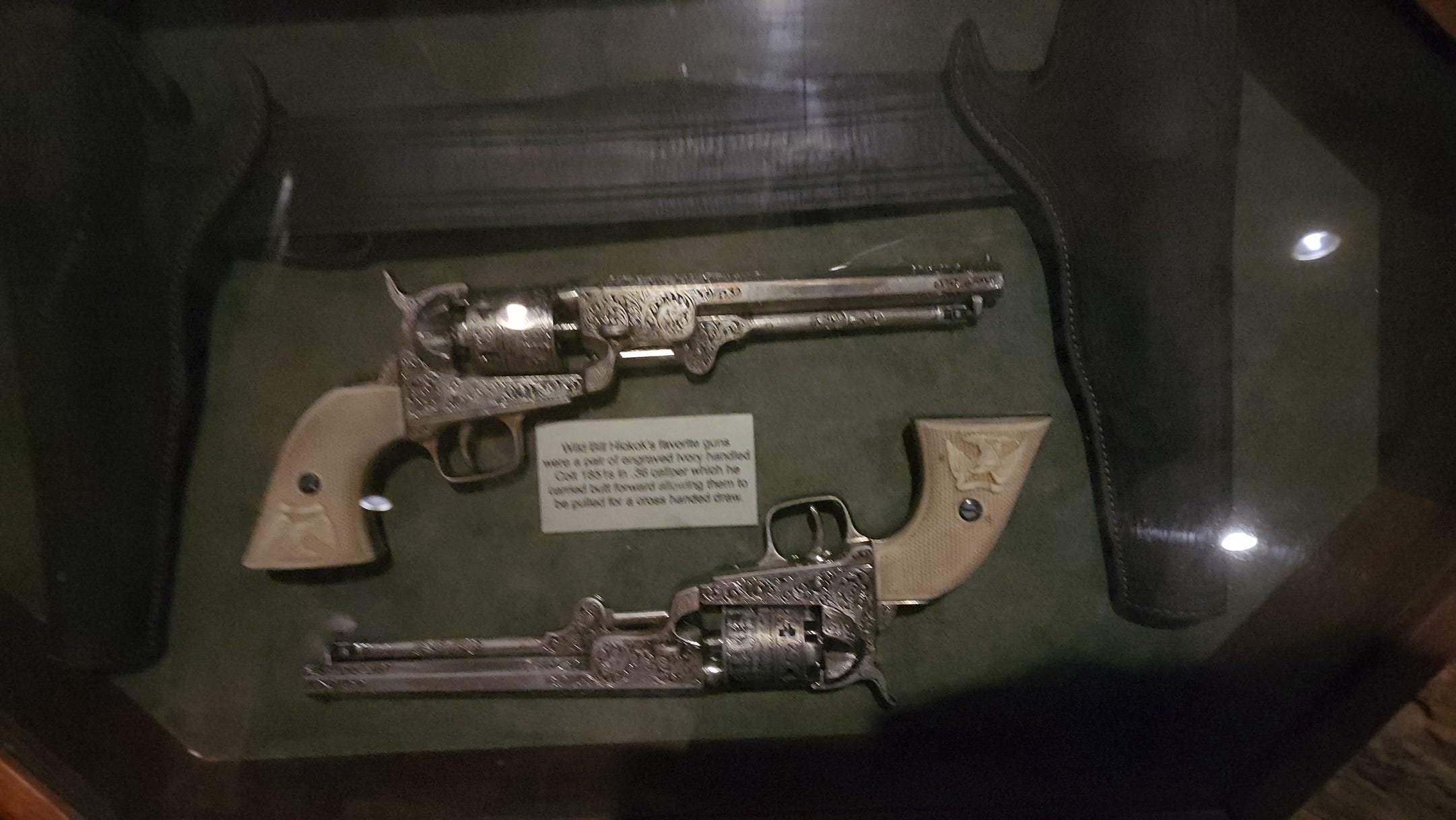
Replicas of his guns are in a case nearby. Two engraved ivory-handled Colt 1851s, .36 caliber, carried butt-forward so he could cross-draw with either hand. He wasn't holding them when McCall came in.
His portrait is on the stone wall. Wide brim hat, long dark hair, knotted necktie. Credited to the Deadwood History Inc. Adams Museum Collection. He's looking at something past the camera. He looks like a man who knew something was coming but not when.
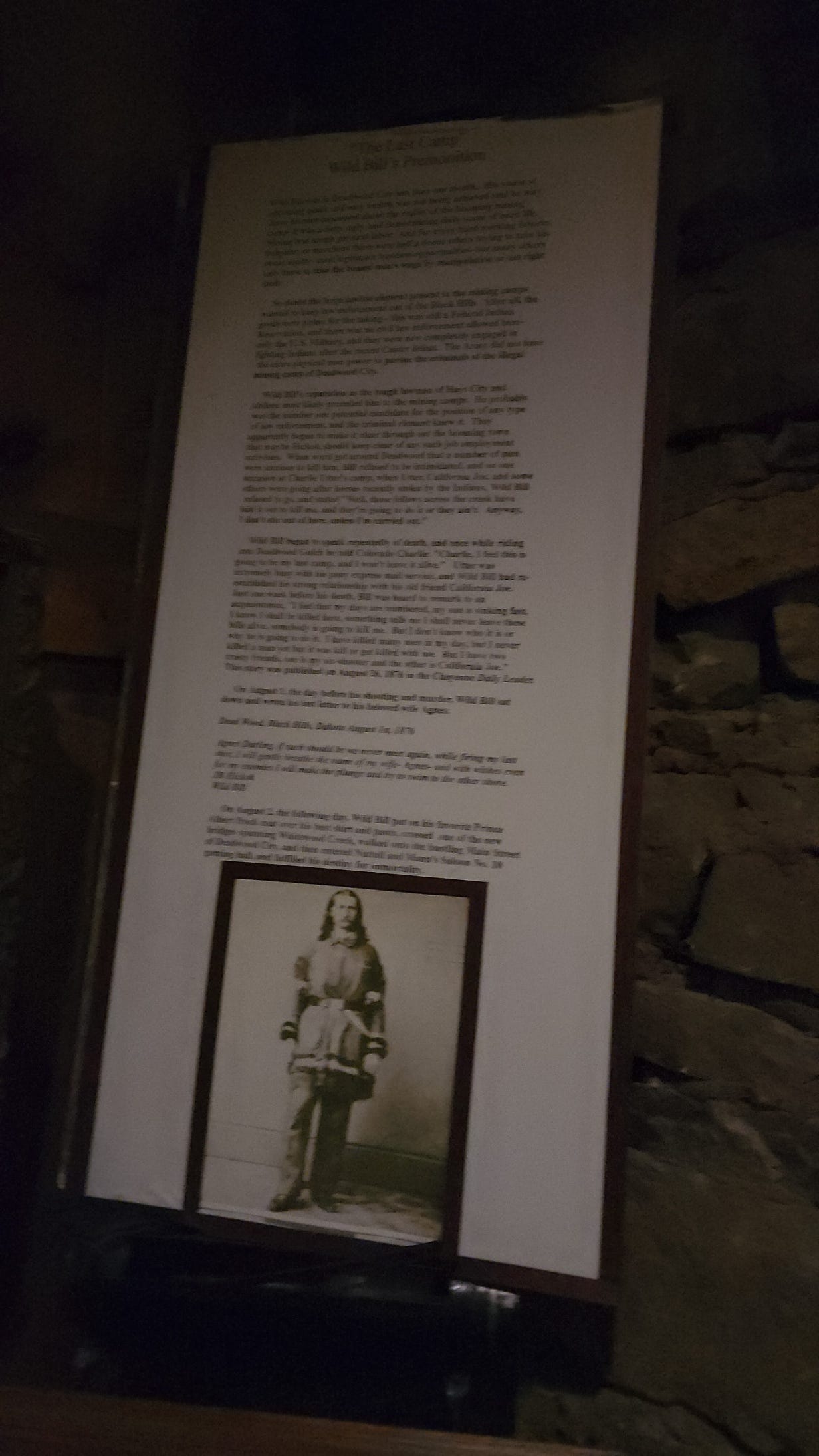
Two full interpretive panels on the wall lay out the whole story. The saloon layout in 1876. The card game on August 2nd. His last letter to his wife Agnes, written the day before. He told her if he never saw her again she should be a good girl. He said he didn’t know who was going to kill him but someone was going to do it.
He was right.
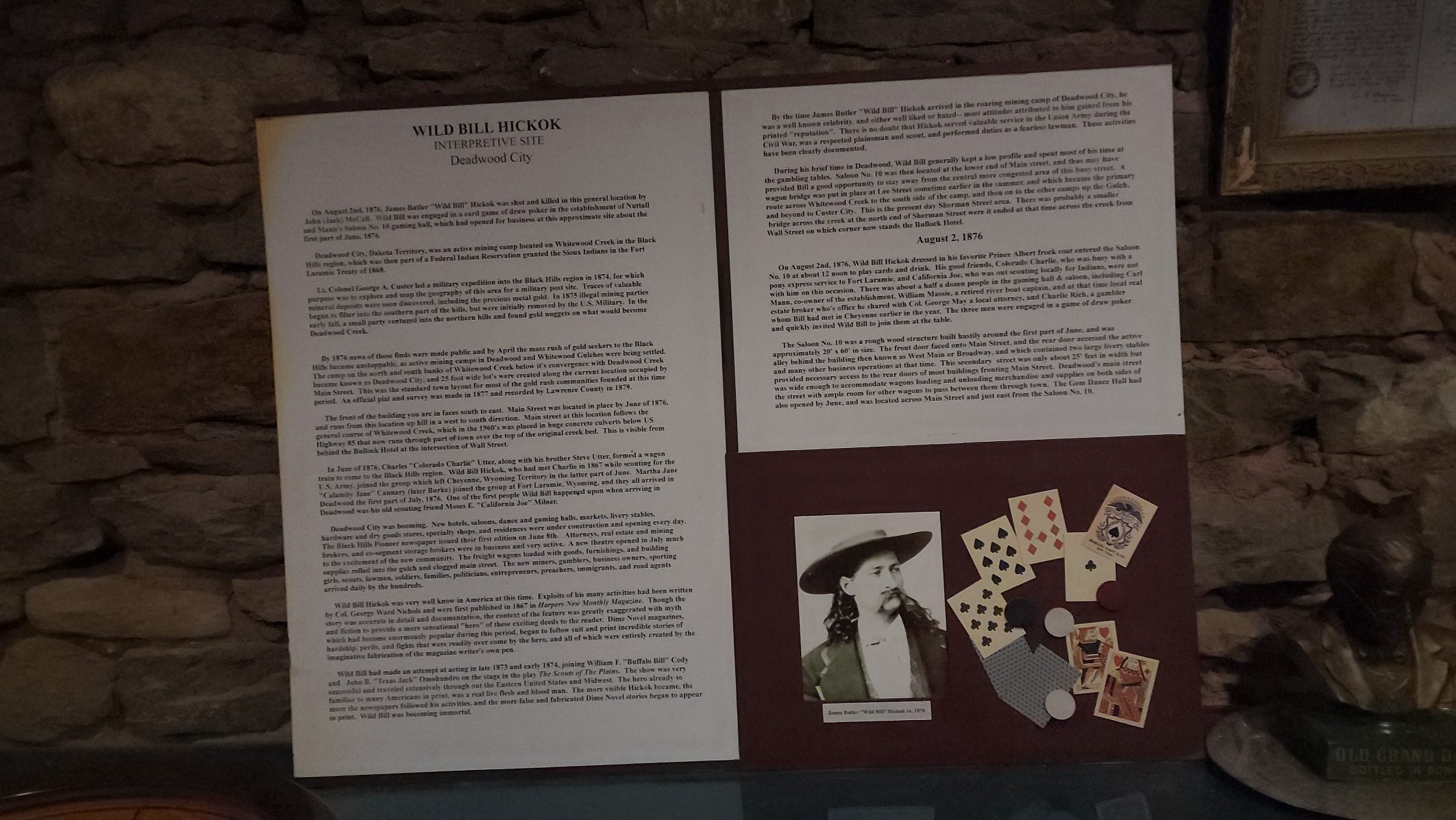
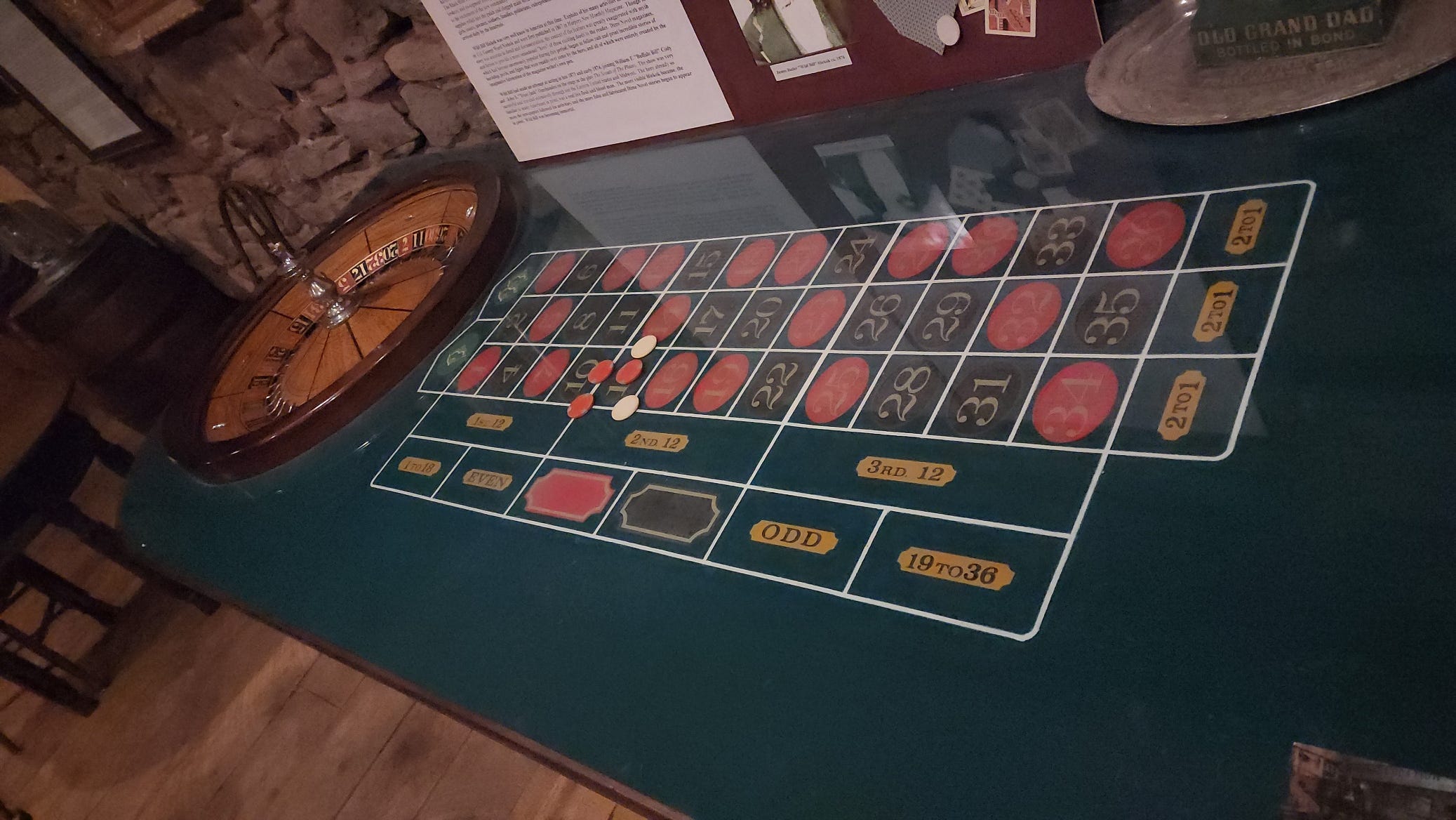
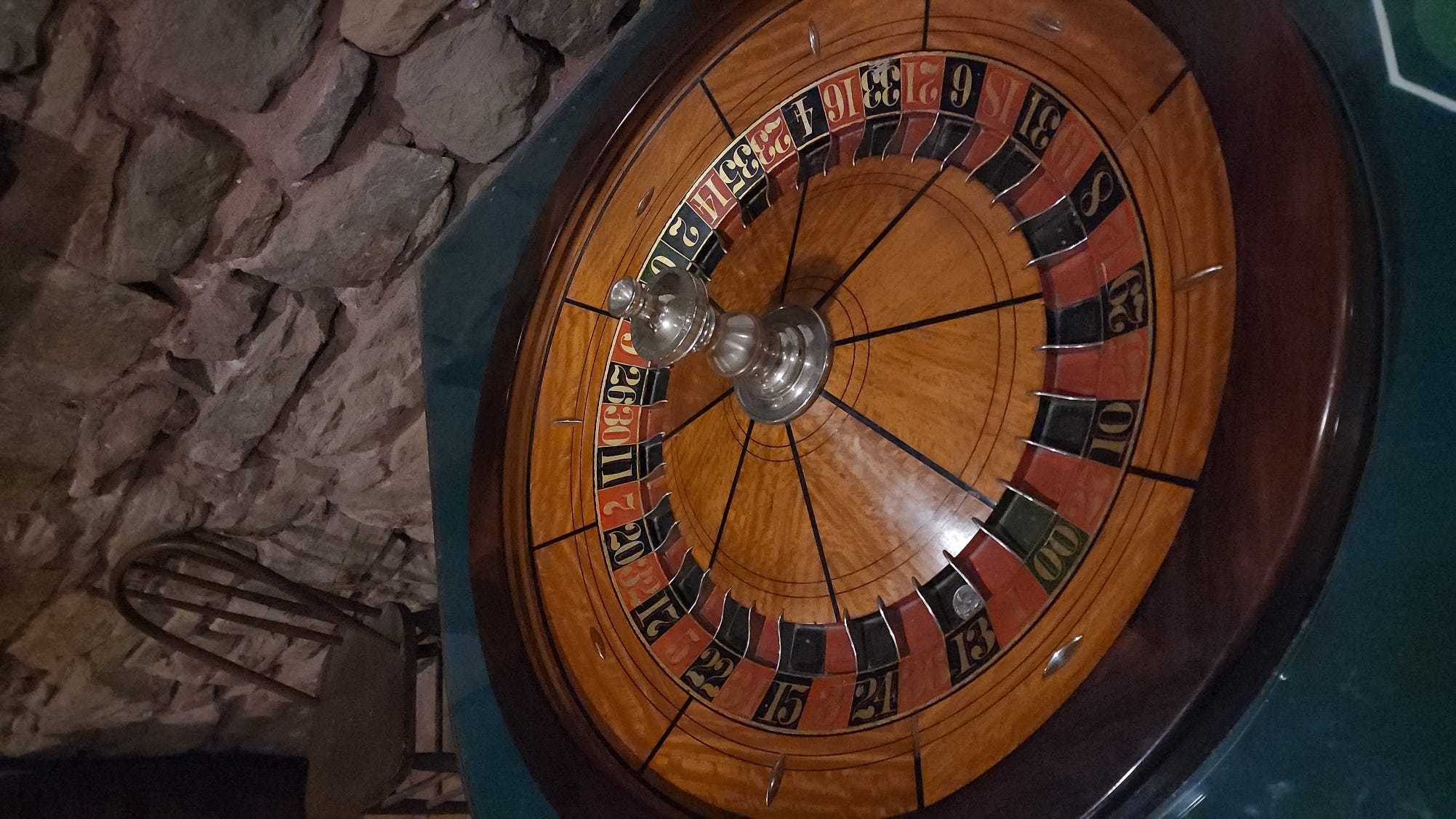
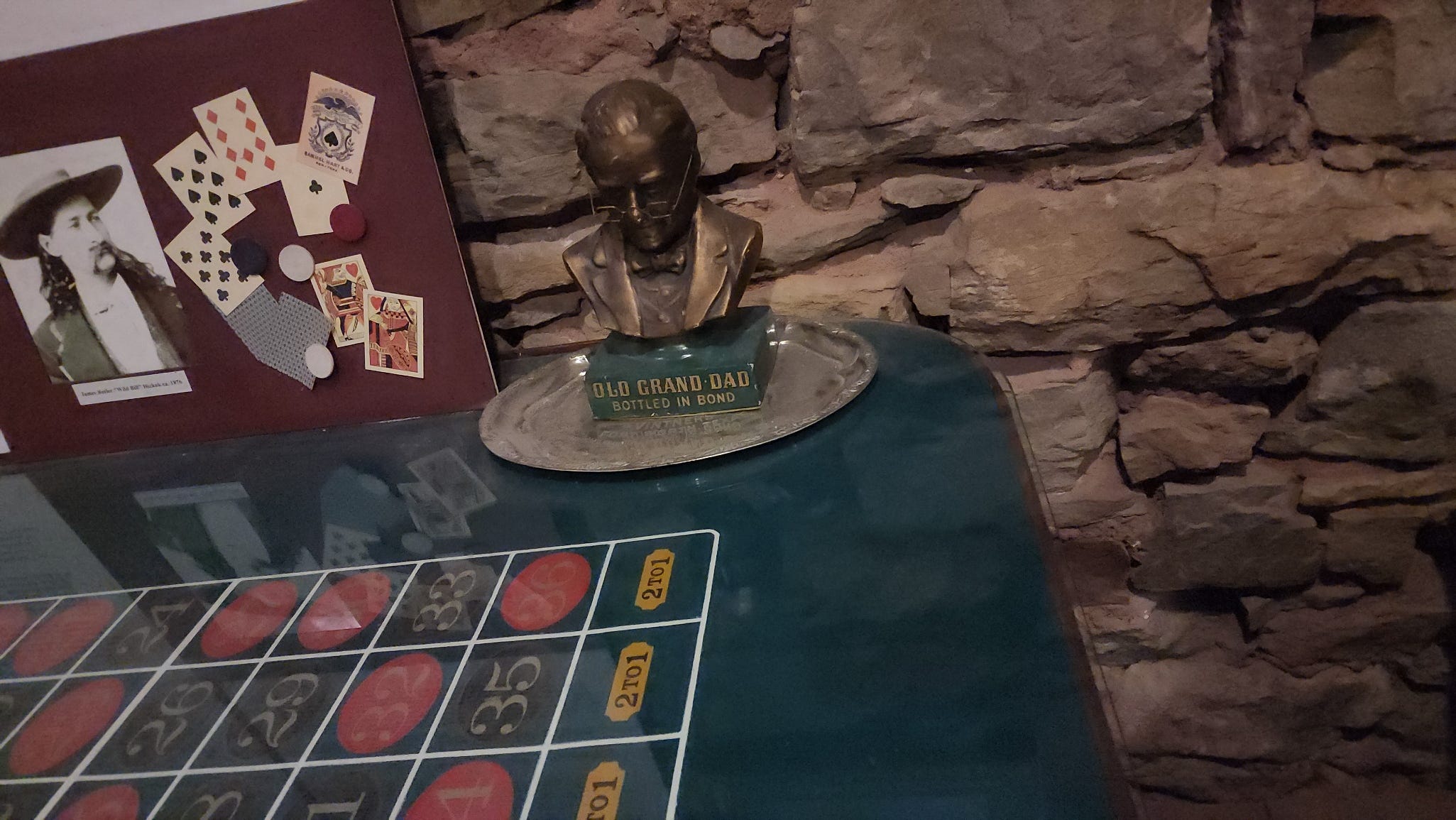
The roulette table is set in the corner, green felt, chips on the numbers, the original wood and brass wheel behind it against the stone wall. Wild Bill's photo is pinned to a board nearby, playing cards spread around him, a bronze Old Grand Dad Bottled in Bond bust sitting on a silver tray next to the wheel. Wild Bill watching the gambling from a corner of the room for 149 years.
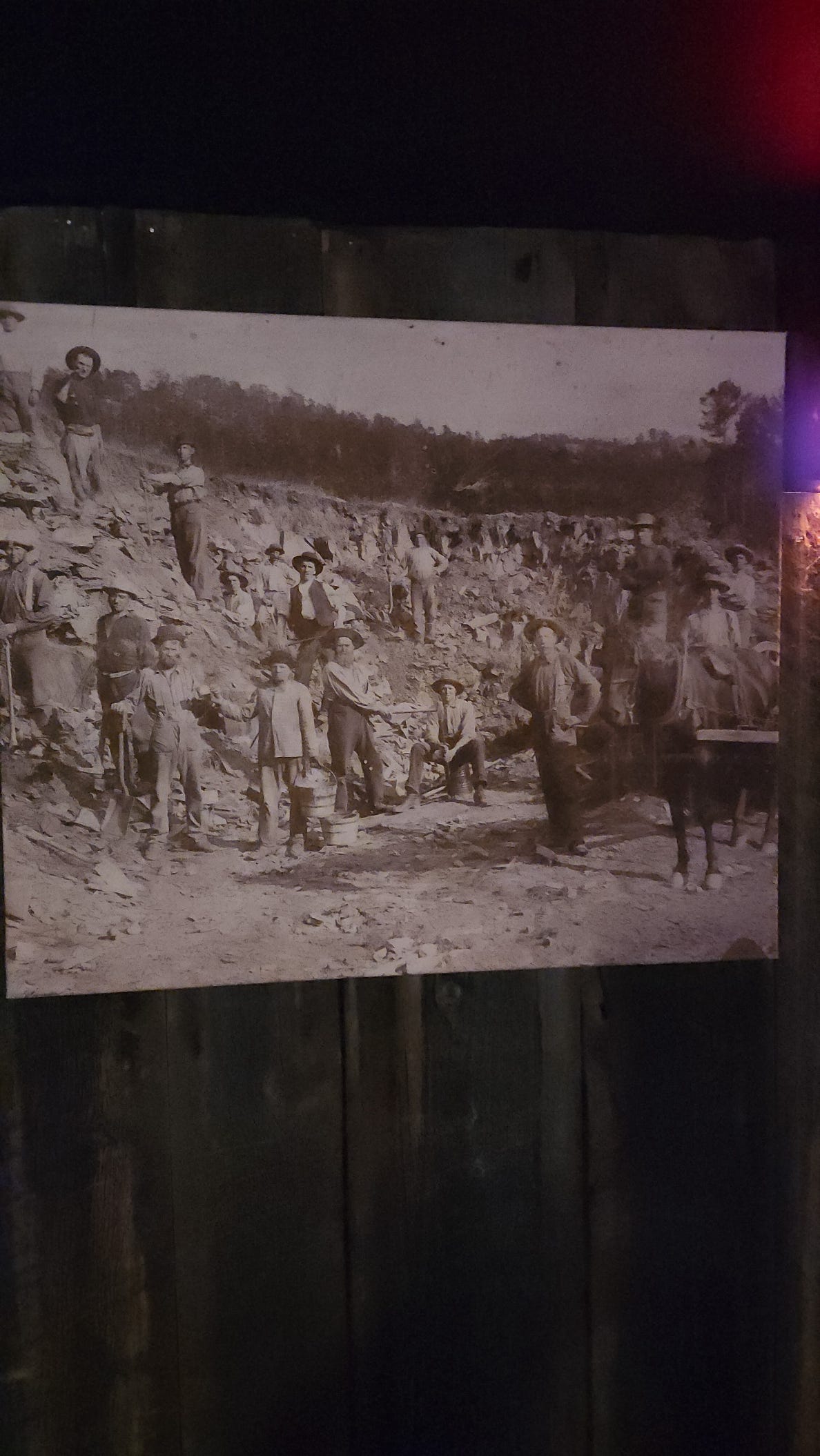
On the back wall, an old photograph. About 25 men on a blasted hillside, some on horseback, all staring at the camera. Rock cuts behind them. Trees at the top of the ridge. No equipment visible, just bodies and shovels and horses. This is Deadwood Gulch in 1876. This is what the hills looked like when the gold was still in them.
I spent six months up on that same hillside in 2024. Different tools. Same rock.
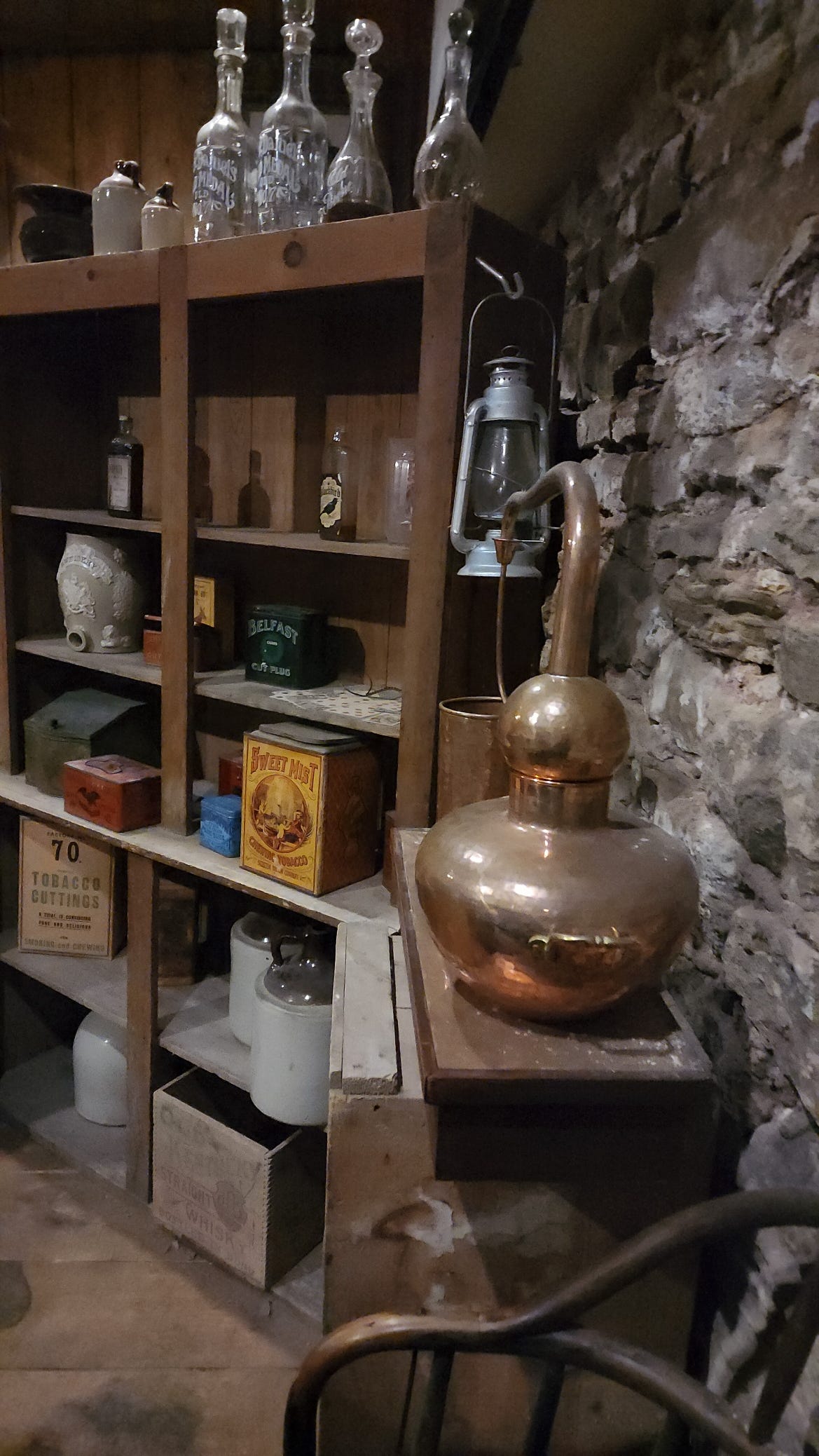
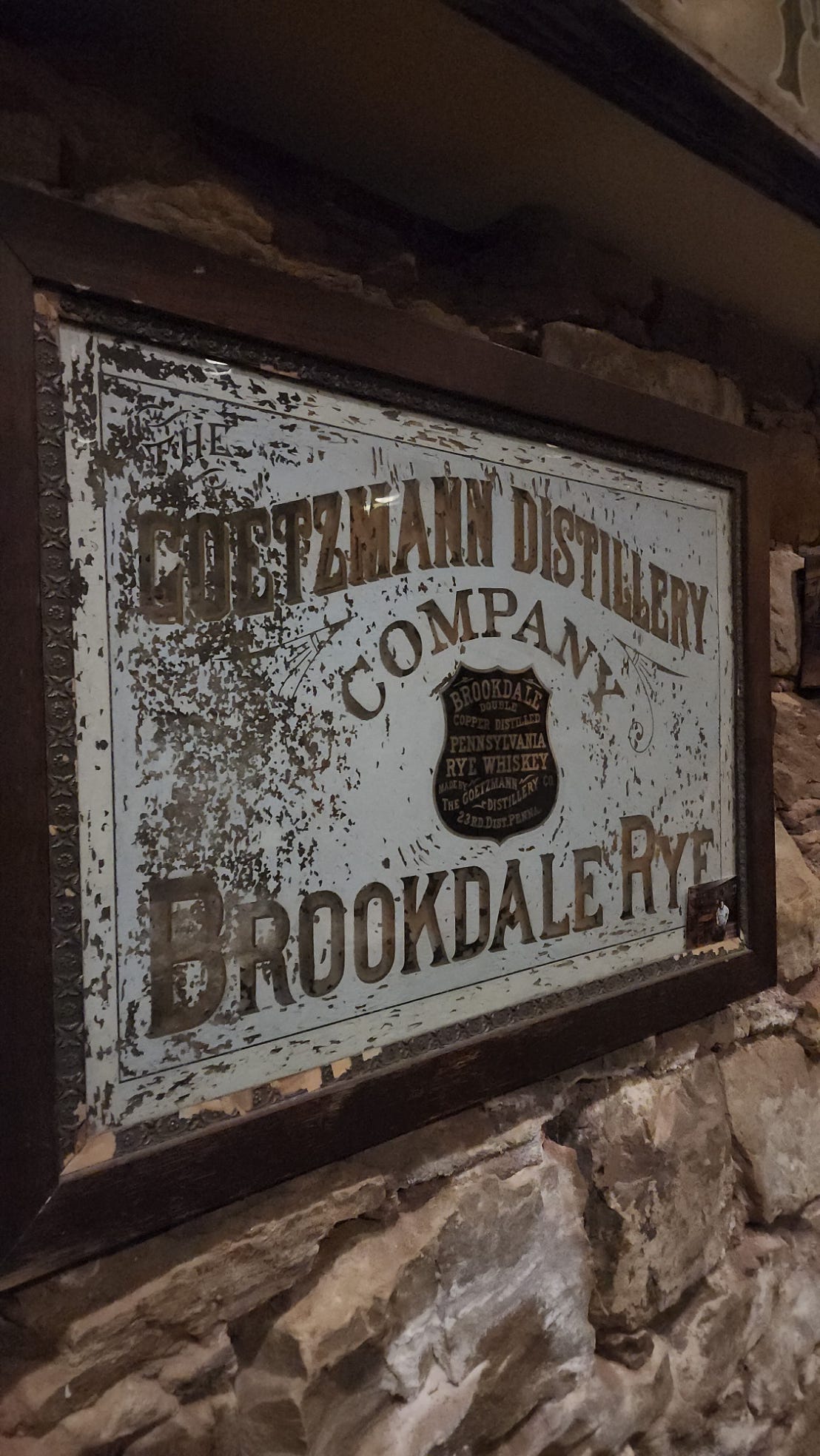
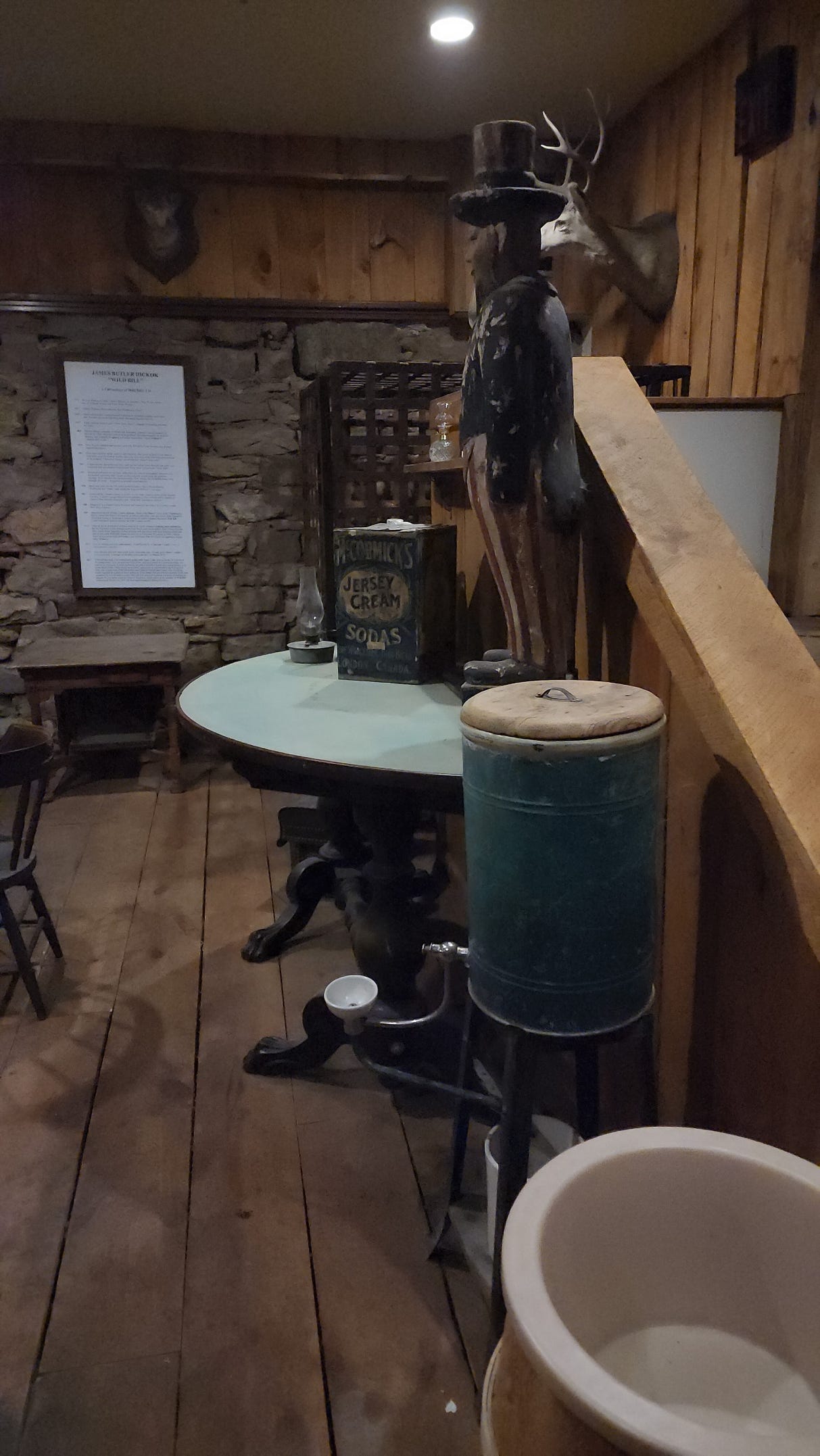
The back shelves hold everything a frontier saloon needed to stay open. Crystal decanters on top, Belfast Cut Plug tobacco, Sweet Mist chewing tobacco tins, a copper pot still, stoneware jugs, an oil lantern, horse tack hanging on the left wall. On the stone wall, a Goetzmann Distillery Company mirror, Brookdale Rye, paint peeling off the frame, silver going dark. Pennsylvania rye whiskey advertised on the wall of a South Dakota saloon in a Black Hills canyon in 1876.
Supply chains haven’t changed that much.
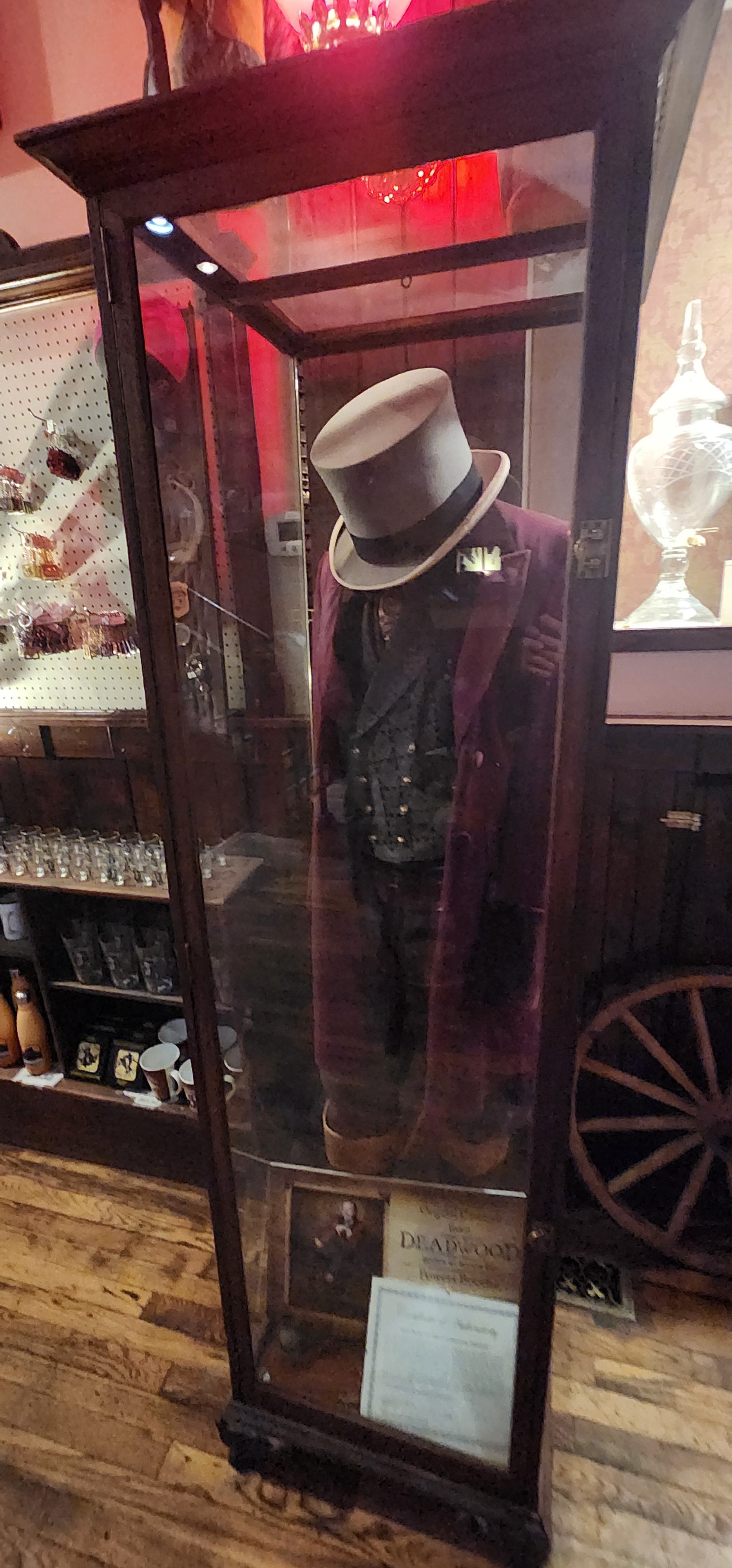
There’s a glass display case in the main room holding what looks like a costume from the HBO series. Burgundy frock coat. Top hat. The plaque references the show. Al Swearengen’s coat, most likely. The real Swearengen was found dead in a Denver rail yard in November 1904. Blunt trauma to the head. Nobody was ever charged.
Deadwood takes care of its legends one way or another.
Watch and Pray
They took me further back. The rooms down there are set up as they were. A cream satin dress on a mannequin next to an enamel washbasin. A brass bed with a patchwork quilt, perfume bottles on the vanity, a red fan in the open drawer, a hairbrush. Someone’s personal effects, preserved behind a rope. On the wall above the bed, a small painted sign.
Watch and Pray.
The walls in the hallway are papered with old newspaper pages. Not decorative. That was insulation. That was wallpaper. That was how you kept the cold out when you were living above a saloon in a canyon in 1876.


I stood in those rooms for a while.
The women who lived here didn’t always get to leave.
The Bison Are Still Up There
Back up on Tatanka Hill, fourteen bison are frozen mid-charge on the hillside right across from where I worked for six months. Native American riders follow behind them. You can’t really see the bronzes before sunrise. But you know they’re there.
The Lakota called the bison tatanka. They called this land Owáyasuta. They had a treaty.
Then came the miners. Then the gold. Then Deadwood. Then another set of rules.
Someone is always drawing a line through these hills.


The Night I Ordered the Drone
We walked back up, back out through the door, back onto Main Street.
February 1st, 2025. 4,530 feet above sea level. Last night.
I stood on that street and looked up at the canyon walls closing in from both sides, the ponderosa pines dark against whatever light was left in the sky, and I thought about every morning I’d spent up on that hill watching the Black Hills do something impossible with the sunrise, and I thought: I should have had a drone up here.
Six months. I had six months in one of the most photographed gulches in American history and I was shooting it all from the ground with a phone.
That was the night I ordered my DJI Neo. Sitting in the truck outside Saloon #10, shipping address set to Florida. Home state. Home.
Deadwood didn’t give me the drone footage. It gave me something better. It gave me the reason.
The Drone Drifter starts here. Six months on a hill in a Black Hills canyon, a co-worker I won’t forget, a glass of Canadian Wicket in a basement saloon where a man got shot in 1876, and a sky I never stopped staring at on the way up every morning.
The DJI Neo was waiting when I got back to Florida.
First flight was everything.
One of the flights that came after Tatanka Hill: https://www.dronedrifter.com/p/the-eye-that-watches-dallas
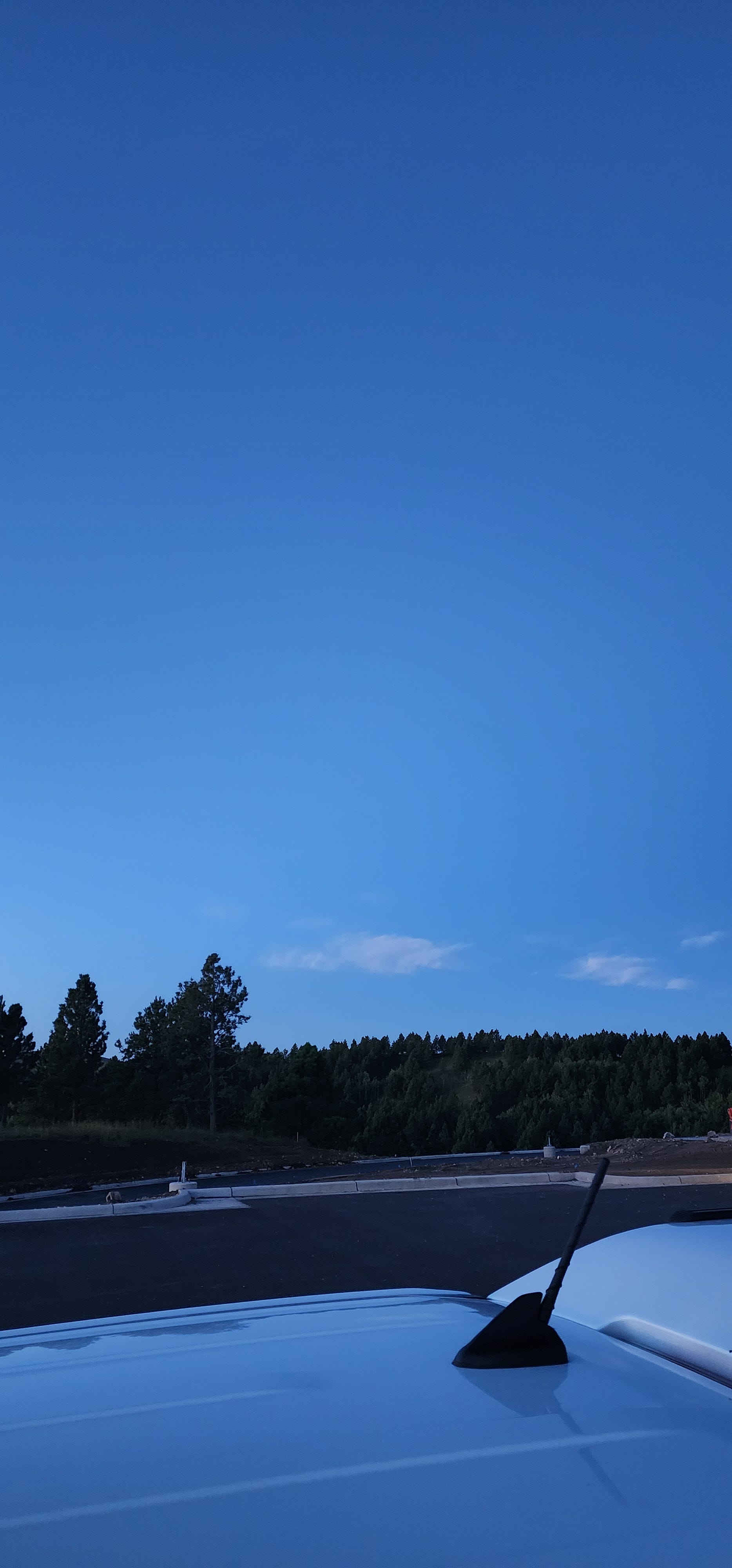
That hill is where the idea started. Subscribe if you want to follow what happened after I finally bought the drone.
I love those old western towns and stories. It's cool that your drone story starts around Deadwood.