


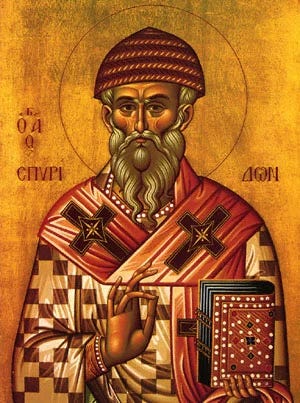
The Hat That Wouldn’t Leave Me Alone
The first thing I noticed about Saint Spyridon was the hat.
It looks almost out of place on a bishop. No jeweled crown. No attempt to hide where he came from. It is a woven shepherd’s cap, the same shape repeated in icon after icon, sitting above the face of a man the Church calls a Wonderworker.
That detail stopped me. A shepherd from Cyprus becomes a bishop, stands at the Council of Nicaea and is remembered sixteen centuries later with the old work hat still on his head.
A Saint on the Road
Spyridon was married and had a daughter named Irene. After his wife died, he became Bishop of Trimythus. Church tradition places him at the First Ecumenical Council at Nicaea in 325, where the argument over Arianism was tearing through the Church.
The polished men had the education. Spyridon had the life he had lived. The stories remember plain speech, stubborn faith and a bishop who never polished the shepherd out of himself.
He died around 350. His body did not stay in Cyprus.
When Arab raids reached Cyprus in the seventh century, his relics were taken to Constantinople. They remained there for centuries. Then the city itself began to close in.
For Orthodox Christians, the relics point to a blunt claim: holiness reaches the body as well as the soul. That belief deserves more care than gawking at a curiosity.
Before Constantinople fell in 1453, a priest named George Kalokhairetes carried the relics of Spyridon and Saint Theodora out. I keep picturing that part: sacred remains packed for escape, roads through Serbia and Epirus, the old capital about to fall behind them.
By about 1460, Spyridon had reached Corfu. He is still there.
Orthodox tradition says Spyridon’s relics remain incorrupt and flexible. His slippers wear down. They are replaced. Then they wear down again.
I can’t prove what happens to those slippers. I can say the story fits the man in the icon. He never seems to sit still. Cyprus. Nicaea. Constantinople. Corfu. Even the hat made the trip.
Maybe that is why Saint Spyridon stays with people. You can put a bishop’s robes on a shepherd. The old cap still tells you who he is.
Wow! The way you are able to tie in history with modern language to really signify the importance of several descriptions is awesome.
Awesome first go!
You describe it as if I were seeing it from drone footage, well done.