
Ghosts, Saints, and Sacred Relics: The Miraculous Journey of Spyridon the Wonderworker

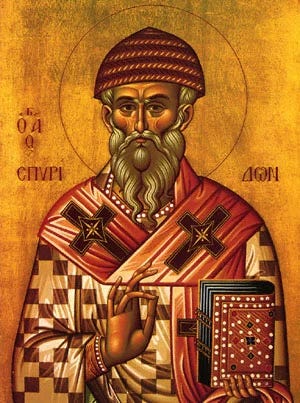
Picture this: You’re cruising through the sun-baked landscapes of Cyprus, the Mediterranean breeze carrying hints of salt and cypress, when you realize you’re traversing the very soil that birthed one of Orthodoxy’s most beloved miracle-workers. Not just any detour; this is a detour to sanctity itself.
Spyridon—shepherd-turned-saint, humble-hearted defender of the faith—began his journey herding actual sheep before God called him to tend a flock of the two-legged variety. Talk about a divine career pivot! Before donning his bishop’s robes in Trimythus, he’d married and fathered a daughter named Irene (whose name, ironically, means “peace”—something Spyridon would later bring to theological battlefields).
When the theological heavyweights gathered at Nicaea in 325 for what would become Christianity’s first all-star council, our shepherd-saint didn’t come packing sophisticated rhetoric or philosophical pyrotechnics. Instead, he brought something the clever Arians never expected: devastating simplicity. While others launched theological missiles, Spyridon reportedly silenced heresy with the conversational equivalent of a well-placed pebble from a spiritual slingshot. The original David versus theological Goliaths!
But here’s where the story gets DJI Mini Pro-worthy for aerial documentation—around 350 AD, Spyridon exits earthly existence, leaving behind not just teachings but something far more Instagram-worthy: his miraculously preserved remains. Fast-forward through four centuries of veneration to the mid-600s, when barbarian raiders forced his relics to take an unscheduled road trip to Constantinople. There, even emperors themselves bowed before the shepherd’s earthly vessel.
The plot thickens faster than a good barbacoa sauce in 1453! With Constantinople about to fall faster than battery life on a drone filming in 4K, a quick-thinking priest named George Kalokhairetes (whose name deserves its own tongue-twister challenge) grabs Spyridon’s remains along with those of Saint Theodora and embarks on a medieval version of “The Amazing Race.”
The sacred convoy zigs through Serbia, zags through Epirus, and finally—around 1460—washes up on the shores of Corfu like spiritual driftwood of incalculable value. While Theodora’s relics became community property, Spyridon’s remained a family heirloom of Kalokhairetes’ descendants—the original family treasure passed down through generations!
Here’s the cliffhanger that’ll have you smashing that subscribe button: 1,500 years after his death, Spyridon’s body remains freakishly well-preserved, with—get this—flexible flesh! No formaldehyde, no modern preservation techniques, just pure, inexplicable miracle status. We’re talking supernatural preservation that would make both morticians and jerky manufacturers jealous!
Truly, as Psalm 67 reminds us between bites of roadside tacos, “Wondrous is God in His Saints!” And if that doesn’t deserve drone footage set to ethereal music, I don’t know what does.
_Want more sacred road trips and miraculous encounters? Hit subscribe for Sunday’s journey to Annunciation Church in Dayton Ohio.
Wow! The way you are able to tie in history with modern language to really signify the importance of several descriptions is awesome.
Awesome first go!
You describe it as if I were seeing it from drone footage, well done.